Emory Authors: Capturing Learner Perspectives: Development and Validation of the Skills-Based Training Evaluation Tool

“Gathering feedback from learners about their experiences with educational activities is vital for continuous quality improvement of learning activities and to gauge the effectiveness of teaching methods. Learners should be viewed as partners in their educational experience and be encouraged to share feedback on teaching and learning strategies, thus creating
a collaborative learning environment with faculty. Learners have valuable insights into the effectiveness and relevance of curricula and teaching methods, and their feedback can lead to more engaging and effective learning experiences, ultimately leading to better student outcomes and preparation for their future professional roles. Asking learners for
feedback about learning activities denotes respect, encourages active engagement in learning, and leads to process improvement. When learners feel heard and valued,
a sense of ownership of their education is created, and a more collaborative learning environment is fostered.”

Continue reading

Hot Topics: Gratitude journals can improve nurses’ mental well-being.

“Since the onset of the pandemic, nurses throughout the US have been feeling the effects of work burnout. The World Health Organization defines burnout as a syndrome that results from chronic workplace stress that has not been effectively managed. Burnout symptoms can range from physical feelings of exhaustion and low energy to reduced professional efficacy. A 2021 study that surveyed 1,834 nurses found that 54% of the respondents were experiencing burnout. The study also revealed a strong correlation between burnout and nursing turnover. With high rates of nursing turnover, care is more disjointed and teamwork for best patient outcomes becomes more difficult. Effective interventions are needed to help support mental health practices among nurses to mitigate high levels of burnout. Otherwise, not only are individual nurses at risk but the healthcare system may also be compromised.

Continue reading

Hot Topics: Staffing and leadership as drivers of nurse retention

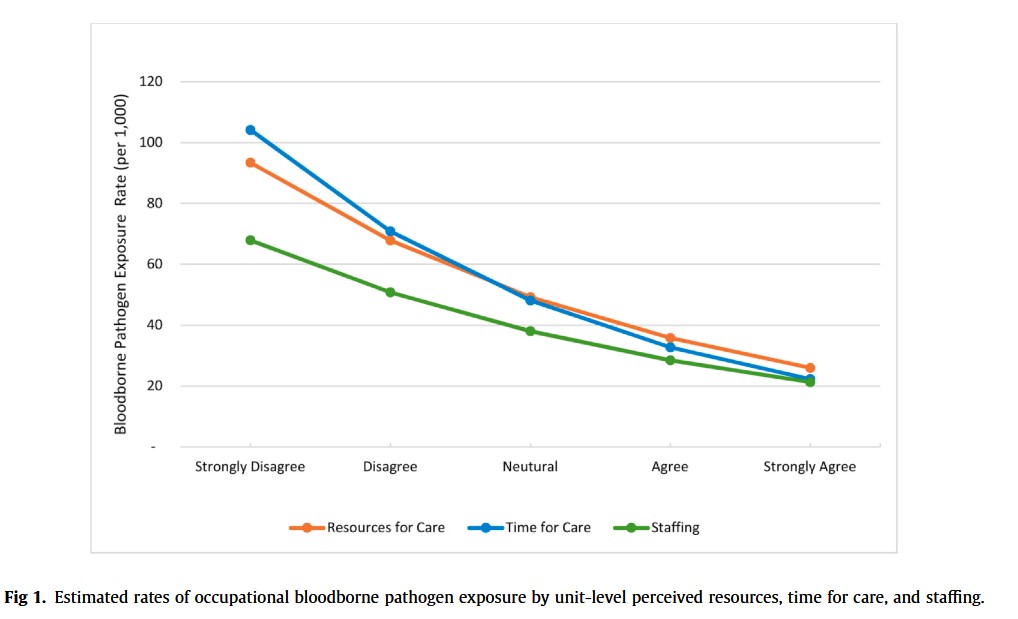
“A significant stressor among nurse managers is the challenge of matching adequate staffing to patient care needs while conserving expenses. Although staffing has been a long-standing challenge, it has steadily grown in complexity since the COVID-19 pandemic. During this time, the number of experienced baby boomer nurses have decreased due to
retirements as younger Generation Z (Gen Z) nurses began entering the profession, creating an “experience-complexity gap.” Meeting the developmental needs of the nursing workforce is just one part of the equation. Gen Z nurses’ changing values toward work
are reflected in their reluctance to work full-time and off-shifts. The increase in part-time nurses means higher numbers of nurses are reporting to individual nurse managers. Further complicating nurse staffing are newer models of care delivery that add licensed practical nurses and virtual nurses into the mix, resulting in increased stress and burnout among
nurse managers. It is imperative that nurse managers implement strategies to mitigate the burdens of their unit workforce.”

Continue reading

Lactation support in the NICU

“Human milk, specifically milk from an infant’s own mother (mothers’ own milk [MOM]), improves short- and long-term outcomes for all infants, leading to recommendations by the
World Health Organization (2018) and the American Academy of Pediatrics Section on Breastfeeding (2012) that infants be fed exclusive MOM until 6 months of age. MOM has particular benefits for infants born preterm, and likely also improves outcomes for other infants who require admission to the neonatal intensive care unit (NICU), including those requiring neonatal surgery for congenital gastrointestinal anomalies.
Although mothers of ill infants admitted to a NICU ideally would provide MOM during the NICU hospitalization and beyond discharge, pump dependency for lactation initiation and
maintenance, maternal-infant separation, and other risk factors including preterm birth, and the associated maternal health conditions like pre-eclampsia, can affect MOM volumes and therefore continued MOM provision.”

Hoban, R., McLean, L., Sullivan, S., & Currie, C. (2022). Proactive lactation care is associated with improved outcomes in a referral NICU. Journal of Human lactation, 38(1), 148-155.

Continue reading

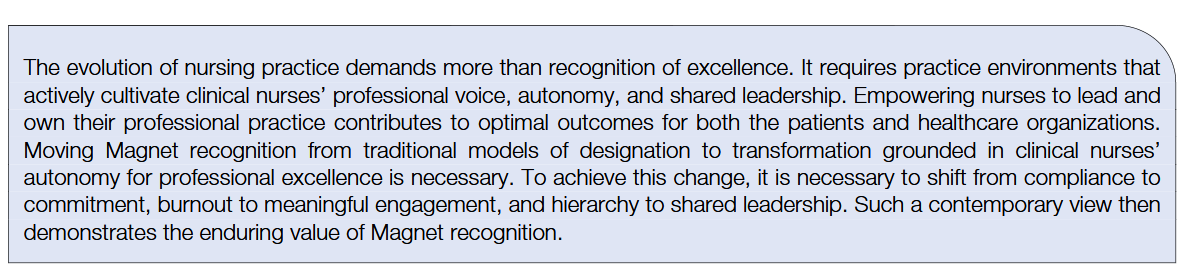
Hot Topics: Assessing the Impact of ANCC Magnet Designation: Insights From a Chief Nursing Officer and a Magnet Program Director

“Magnet program directors (MPDs) serve as facilitators in guiding healthcare organizations through the process of attaining and sustaining Magnet designation. As architects of nursing excellence, MPDs strive to align organizational goals with Magnet standards to continually improve quality outcomes, adhere to evidence-based practices (EBPs), and foster a culture of excellence. A critical aspect of the role is the pursuit of empirical outcome measures, which reflect the impact of nursing interventions on patient care. These differ from process measures, which capture improvement efforts but not necessarily their results. Anchoring nursing practice to empirical outcomes provides context for comparing nursing-sensitive indicators against national benchmarks, a key requirement for successful designation.”

  • Evidence synthesis suggests Magnet recognition is
    associated with improved nurse work environments
    and selected patient outcomes, particularly mortality,
    failure to rescue, patient satisfaction, and fall prevention,
    while findings for infections, pressure injuries, length of
    stay, and perioperative complications are mixed.
  • Achieving Magnet status boosts the hospital’s reputa-
    tion, nurturing the hospital’s competitive edge. It con-
    tributes to the structural score in most specialties of US
    News Best Hospitals, reflecting nursing excellence as
    recognized by the ANCC.
  • Some chief financial officers suggest Magnet recognition
    may be viewed favorably by bond rating agencies as part
    of broader assessments of organizational stability.
  • Magnet hospitals can attract highly qualified and ambi-
    tious nurses, strengthening the workforce and contribut-
    ing to improved patient care.
Continue reading

Emory Authors: Transforming Nursing Education with Artificial Intelligence: A Systematic Review (2010–2025)

“AI technologies encompass a wide range of applications within nursing education. These include intelligent tutoring systems for personalized learning, machine learning platforms
for performance prediction, virtual and augmented reality tools for clinical simulation, and automated systems for assessment and feedback. AI modalities such as natural
language processing, generative models like ChatGPT, decision-support tools, and rule-based algorithms are increasingly being deployed across educational contexts to assist both learners and educators. The scope of this review includes populations such as pre-licensure nursing students, nurse educators, and continuing education participants across academic,
clinical, and hybrid learning environments.”

Continue reading

Patient perception of clinicians’ scrub colors

“A 2023 letter published in JAMA Surgery examined patient preferences regarding the color of scrubs physicians wore and found that patients most identified physicians wearing green scrubs as surgeons and those wearing blue scrubs to be the most caring, whereas those wearing black scrubs were associated mostly with negative characteristics (least knowledgeable, skilled, trustworthy, and caring)

Firouzbakht, P. K., Zhang, A., Nguyen, D. C., Slovacek, C., Daytz, A. E., Tanna, N., & Chen, K. (2024). Public Perception of Scrub Color and Style in Plastic Surgery. Plastic and Reconstructive Surgery. Global Open, 12(6), e5888.

Continue reading