Emory Authors: Capturing Learner Perspectives: Development and Validation of the Skills-Based Training Evaluation Tool

“Gathering feedback from learners about their experiences with educational activities is vital for continuous quality improvement of learning activities and to gauge the effectiveness of teaching methods. Learners should be viewed as partners in their educational experience and be encouraged to share feedback on teaching and learning strategies, thus creating
a collaborative learning environment with faculty. Learners have valuable insights into the effectiveness and relevance of curricula and teaching methods, and their feedback can lead to more engaging and effective learning experiences, ultimately leading to better student outcomes and preparation for their future professional roles. Asking learners for
feedback about learning activities denotes respect, encourages active engagement in learning, and leads to process improvement. When learners feel heard and valued,
a sense of ownership of their education is created, and a more collaborative learning environment is fostered.”

Continue reading

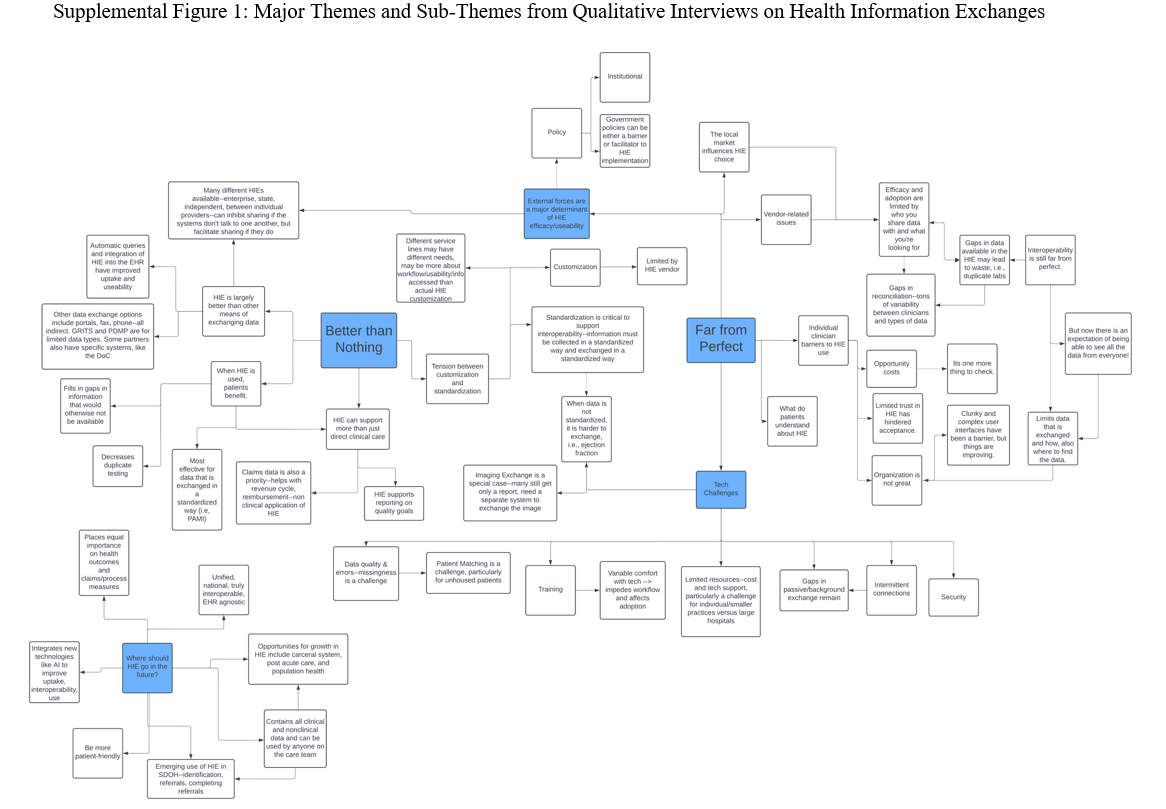
Emory Authors: Better than nothing, far from perfect: hospital and healthcare system leaders’ perspectives on health information exchanges

“Implementation and effective use of health information exchanges (HIEs)—systems that electronically share clinical and administrative data between settings of care—has the
potential to transform health care and improve patient out-comes. Financial investments in HIE infrastructure and the achievement of a critical mass of hospitals and health systems
participating in information sharing have mitigated key structural barriers to HIE use, while technological innovations, including the incorporation of HIE into electronic health records (EHRs), have improved integration of HIEs into many clinicians’ workflows. However, real-world use of HIE is lagging: it is estimated that HIEs are accessed in less than 20% of
clinical encounters and in only 50% of referrals—despite being a part of required reporting for the Centers for Medicare and Medicaid Services Promoting Interoperability incentive
program. Health information exchange use varies widely across settings of care: as few as 3.7% of outpatient visits and 17.6% of inpatient admissions recorded HIE use in one study.”

Continue reading

Emory Authors: Capture of Patient Itch Scores in Practice Reveals Disparate Itch Impact on the Basis of Age, Gender, and Race: A Cross-Sectional Survey Analysis

“The complete impact of skin disease on patients represents a sum of disease impacts in multiple domains, including symptom, emotional, and functional impacts. These domains
define the patient’s illness experience, which can be different from what physicians perceive when they examine the skin. Consistently capturing and quantifying disease impact in individual patients in routine clinical dermatology practice are difficult. Measures of disease activity, when captured in dermatology practice, tend to focus on objective measures such as skin erythema and scale or body surface area involved. Skin symptom burden may not readily be observed by clinicians, resulting in underestimating skin disease burdens.”

Continue reading

Emory Authors: Re-viewing the concept of saturation in qualitative research

“The term saturation is used ubiquitously in reports of qualitative research. The term is often used, however, as a throw-away line, sans definition, rationale, or explanation of the process. Consequently, there remains a question about what is meant when saturation is used.The concept of saturation originated in grounded theory. Achieving theoretical saturation is one of the tenets of grounded theory. Over time, this specific and singular term has migrated to a general term that reflects various types of saturation such as code, data, theme, and meaning saturation. There is a lack of clarity among saturation types and a lack of transparency in reporting what is meant by saturation and how it was achieved. There is also a question about the relevance of saturation to qualitative methodologies outside grounded theory.”

Continue reading

Emory Authors: Nursing’s Commitment to the Principles of Diversity, Equity,and Inclusion

“The history of American nursing is a record of care across social, racial, economic, and geographic lines. The profession has long aligned itself with the needs of the underserved,
sometimes in direct opposition to the social norms of the time. One of the earliest examples are Lillian Wald, a New York nurse and social reformer serving the immigrant community of New York City’s lower east side, and Mary Eliza Mahoney, who became the first African American professionally trained nurse in the United States in 1879. Both, in their own ways,
championed equity and integration in nursing education and care, laying a foundation for social and racial equity in the profession.”

Continue reading

Emory Authors: Confidence, commitment, and control: Nursing faculty experiences with teaching LGBTQ+ health

“Nursing education research demonstrates that lesbian, gay, bisexual, transgender and queer (LGBTQ+) health receives scant attention in nursing curricula. The American Nurses Association (ANA) advocates for “Nurse educators that will help fill the void in knowledge by incorporating the issues of the LGBTQ+ populations as part of the curricula”. Calls to
action from scholars and professional nursing organizations demonstrate that while nurse educators are responsible for including LGBTQ+ related content in nursing curricula, these topics are not adequately suffused into nursing training.”

Continue reading

Emory Authors: Fluid Resuscitation in the Treatment of Acute Pancreatitis: Rate and Volume Controversies

“The aim of the Research to Practice column is to enhance the research critique abilities of both advanced practice registered nurses and emergency nurses, while also aiding in the translation of research findings into clinical practice. Each column focuses on a specific topic and research study. In this article, we used a scenario of left upper quadrant pain to explore the study by de-Madaria et al., titled “Aggressive or moderate fluid resuscitation in acute pancreatitis”.

Continue reading