
“The shortage of nursing staff represents one of the most significant challenges for healthcare systems worldwide. According to estimates by the World Health Organization, the global nursing deficit decreased from 6.2 million in 2020 to 5.8 million in 2023, with a further reduction to 4.1 million projected by 2030. Despite this trend, the literature highlights how this shortage remains a structural issue, mainly associated with the aging of the workforce, the reduced attractiveness of the nursing profession, with a consequent decrease in enrollments in training programs, the increase in burnout among healthcare professionals following the COVID-19 pandemic, and the growing demand for healthcare linked to the prevalence of chronic diseases. Population aging and the increase in chronic diseases contribute to a higher demand for care, requiring an ever-growing number of nurses who are adequately trained to respond to emerging care needs. These structural factors have been further amplified by the COVID-19 pandemic, which has exacerbated pre-existing challenges and highlighted the urgent need to improve the working conditions of nursing staff in order to ensure sustainable and effective professional practice. Within this context, the capacity of healthcare organizations to retain qualified nursing staff has emerged as a key determinant of the sustainability and effectiveness of health systems globally.”
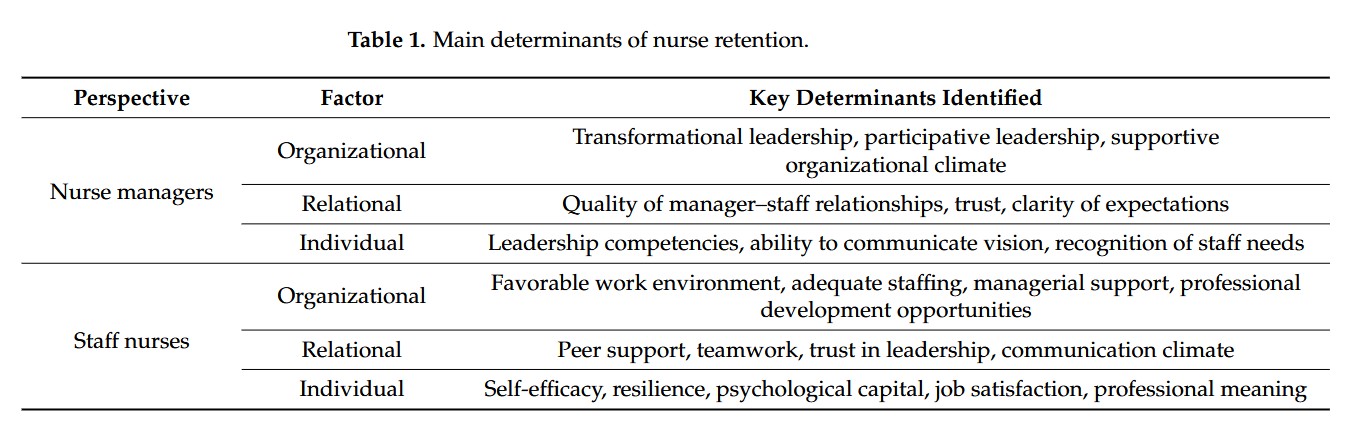
“The findings highlight how nurse retention requires the adoption of integrated strategies capable of acting synergistically on the organizational environment, on professional
relational dynamics, and on the individual resources of healthcare staff. Interventions
limited solely to improving structural conditions are in fact insufficient if they are not
accompanied by measures aimed at strengthening intrinsic motivation, sense of organizational belonging, and perceived control over one’s work role. Healthcare organizations are therefore called upon to promote sustainable work environments and to invest systematically in training managers in transformational leadership, to enhance the levels of support, recognition, and professional development perceived by nursing staff. At the same time, programs aimed at strengthening the self-efficacy and psychological well-being of staff can significantly contribute to consolidating their intention to remain in service, especially in settings characterized by high care complexity. From this perspective, nurse retention should be conceptualized and monitored as a strategic indicator of organizational quality and of the overall sustainability of the healthcare system.”
Guillari, A., Abagnale, M., Palazzo, C., Fulco, M. A., Rea, T., & Giordano, V. (2026). Nurse Retention in Hospitals: A Multilevel Integrative Review of Organizational Determinants. Healthcare (Basel, Switzerland), 14(6), 772. Free Full Text

