
“Consumer health wearables—commercially available health tracking devices such as
smartwatches and other wearable sensors coupled to smartphones—have become
broadly adopted in the United States. A 2024 study found that 44.5% of Americans
reported using a wearable on a regular basis. These devices are designed to
passively and continuously collect physiological data, offering users a convenient,
data-driven, and readily available means of engaging with indicators of their health.
Biometrics tracked by consumer wearables with demonstrated links to health status
include heart rate, heart rate variability, blood oxygen saturation, electrodermal activity, blood pressure, and indices of sleep quantity and quality, among others.”
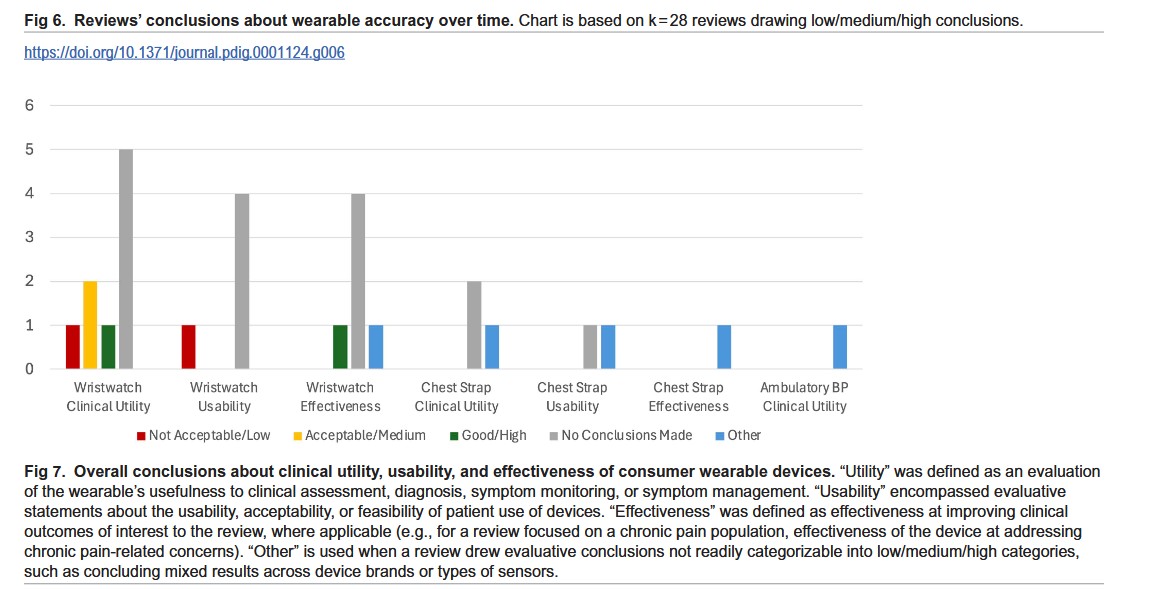
“Results from this review suggest that there is not sufficient evidence to recommend the use of consumer wearables for self-monitoring to the millions of individuals living with PASC and other post-acute infection syndromes. Evidence suggests that wearables are suitable for atrial fibrillation detection and for HR monitoring when patients are comfortable with margins of error. For both biometrics, the largest volume of evidence supporting acceptable device accuracy exists for Apple Watch, possibly supporting a current recommendation for this brand in particular—although this may be partially a function of publication bias in what devices are most commonly included in review-level analyses. Little evidence was
available for biometrics that may be of interest to individuals with shortness of breath, such as blood oxygen saturation or V02 max. For biometrics relevant to activity pacing, there was either limited evidence or clear evidence of weakness: EE was found to have low accuracy overall, and step counts were found to have low accuracy among individuals with slow
gait speeds, an abnormality that frequently occurs in PASC. There was no review-level evidence to support the idea.”
Kaplan, D. M., Kessler, N., Pozzo, N. S., Doyle, C. Y., Dickey, P., Giordano, N. A., Lehther, A., Maan, S., Mascaro, J. S., McDowall, A., Peterson, S., Sirsi, H., & Palitsky, R. (2026). Can consumer wearables support outpatient health monitoring for patients with post-acute infection syndromes? A systematic umbrella review of accuracy, validity, and clinical utility data. PLoS Digital Health, 5(6), 1–28. https://doi-org.proxy.library.emory.edu/10.1371/journal.pdig.0001124
that detection or self-monitoring via wearables leads to improved downstream outcomes (e.g., reduced morbidity, better
self-management, reduced healthcare utilizatio

