JONA Highlights: No more unimplementable nurse workforce planning.

“Mathematical Programming (optimisation) (MP)-based nursing research has been published for nearly thirty years almost exclusively in industrial engineering or health business administration journals, demonstrating a widening gap between nursing research and practice. Nurse scientists’ knowledge and skill of MP is insufficient, as are their interdisciplinary collaborations, setting back the advancement of nursing science. Above all, nurse scientists skilled in decision science are desperately needed for that analytic intellection which is rooted in the intrinsic nature and value of nursing care. It is imperative that nurse scientists be well-prepared for the new age of the Fourth Industrial Revolution through both an education in MP and interdisciplinary collaboration with decision science experts in order to prevent potential stereotyped MP-based algorithm-driven destructive influences.
The current global nursing shortage makes optimal nursing workforce staffing and scheduling more important. MP helps nurse executives and leaders to ensure the most efficient number of nurses with the most effective composition of nurse staffing at the right time for a reasonable cost. Nurse scientists urgently need to produce a new nursing knowledge base that is directly implementable in nursing practice.” (Park)

Continue reading

Emory Authors: Reimagining the Preceptor Role.

“Preceptors are responsible for departmental specific orientation and shaping the development of the new graduate in the early weeks and months of their nursing career. Turnover of direct care nurses has increased at an alarming rate since the start of the pandemic and new graduate nurses continue to be in high demand, but the diminishing number of qualified preceptors presents a challenge. Innovative approaches are needed to make way for increasing the pace of hiring and onboarding new graduates. A group orientation approach was identified as an opportunity to re-design orientation for newly licensed registered nurses in an employer-based transition to practice nurse residency programs. Findings from the first cohort suggest that leaders, preceptors, direct care nurses, and new graduate orientees were satisfied with a group orientation model. Preparing novice nurses to enter practice requires organizational commitment and resources. Group orientation may be a useful approach to foster new graduate nurses’ transition to practice and advance the preceptor role.” (McDermott)

Continue reading

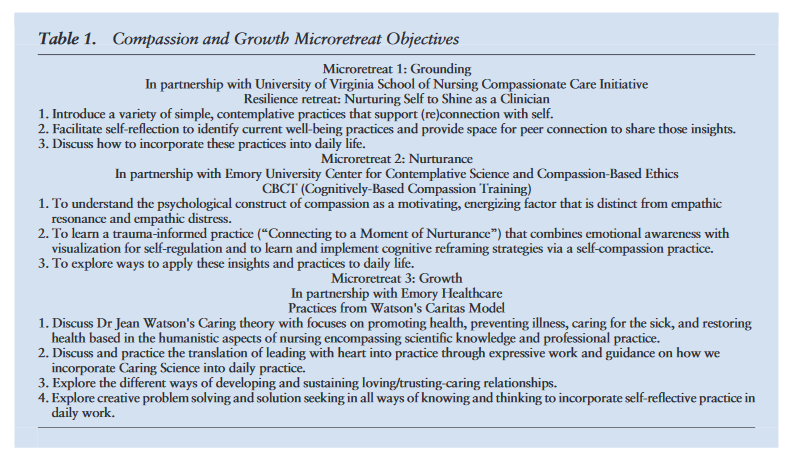
Emory Authors: Changes in Posttraumatic Growth After a Virtual Contemplative Intervention During the COVID-19 Pandemic:

“Contemplative interventions can substantively improve posttraumatic growth. This may be particularly relevant for coping with COVID pandemic stress among nurses on the frontlines and for healthcare leaders seeking to strengthen psychological support within their teams and reform the workplace environment”

Continue reading

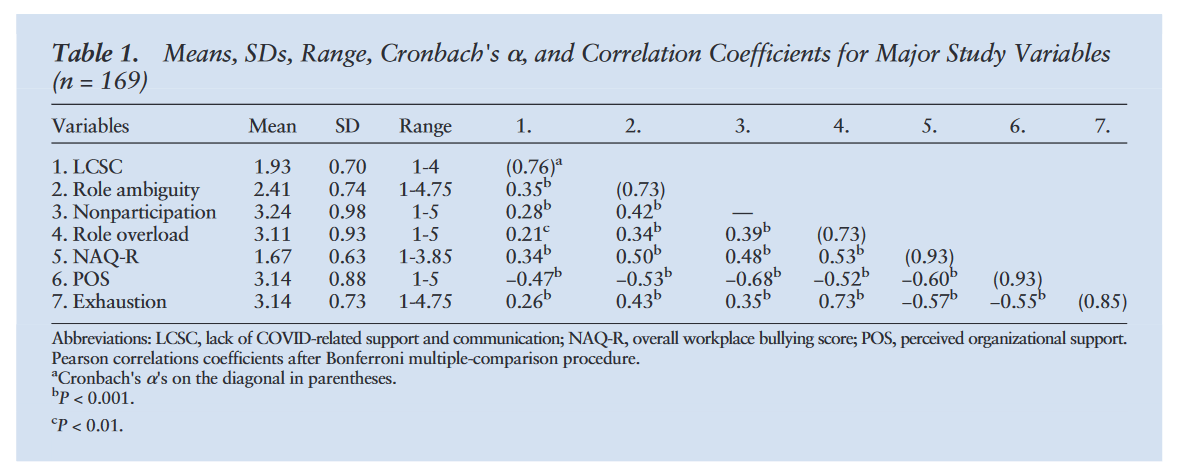
JONA Highlights: The Effect of Work Stressors on RN Exhaustion

“The conservation of resources theory suggests that individuals experience stress when they are threatened by resource depletion, lost resources, or failure to get resources after a significant effort. When workers continuously face such conditions, they are more likely to experience psychological burnout.”

“Stressful and poorly organized work environments may give rise to conditions resulting in bullying. Workplace bullying is the persistent exposure to negative acts, which may be psychological,verbal, or physical. Several work stressors (eg, workload, role ambiguity, decision authority, interpersonal conflicts, tyrannical and laissez-faire leadership behaviors) were associated with bullying.”

Filipova, Anna. (2023). The Effect of Work Stressors on RN Exhaustion: The Role of Perceived Organizational Support. The Journal of Nursing Administration, 53, 146-153.

JONA Highlights: Retention Outcomes of New Graduate Nurse Residency Programs

“Nurse Residency Programs can increase 1-year retention of new graduate nurses. More controlled and comparative studies are needed to evaluate program differences. Nurse leaders need evidence to ascertain which programs are the most effective in supporting retention and return on investment.

Continue reading

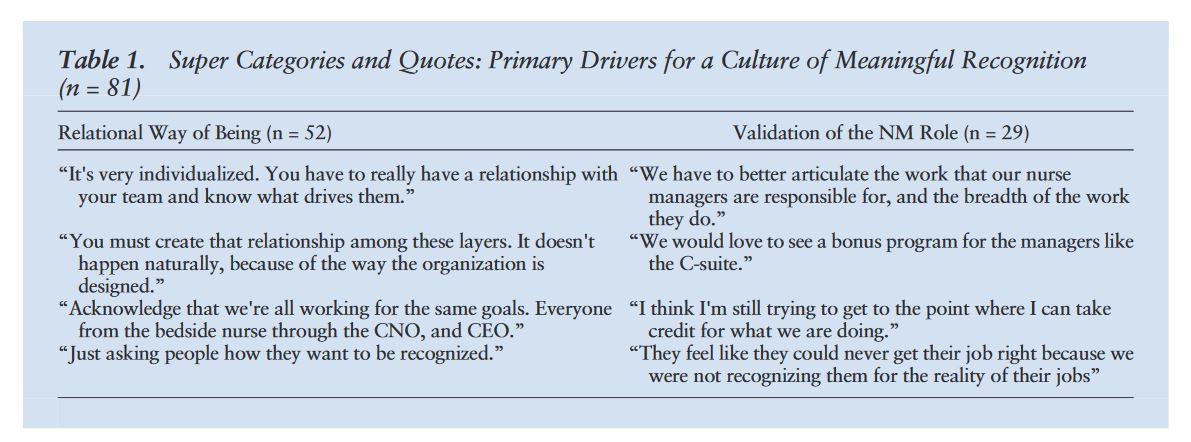
JONA Update: Recognizing What Meaningful Recognition Is to Nursesas a Strategy for Nurse Leaders

Meaningful recognition to nurses is as diverse as the nursing population. It is important that instruments be developed to capture the rich cultural and ethnic differences in relation to what is considered meaningful recognition to the nursing workforce. Although pay, public recognition, and opportunities for advancement were seen in this study as important forms of meaningful recognition, a deeper exploration across ethnic, racial, and gender groups is needed. This study underscored that one size of meaningful recognition does not fit all.

Sweeney, Cynthia, et al (2023). Retaining the Best: Recognizing What Meaningful Recognition Is to Nurses as a Strategy for Nurse Leaders. The Journal of Nursing Administration, 53, 81-87.