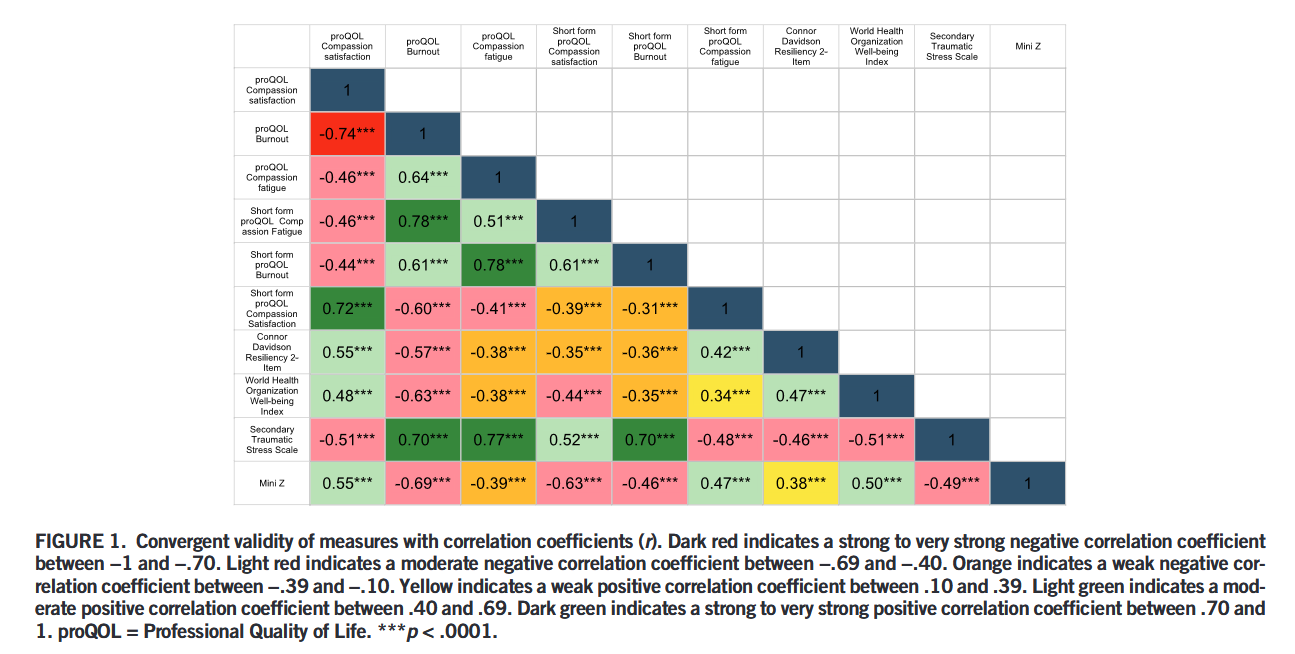
Emory Authors: Reliability and Validity of Measures Commonly Utilized to Assess Nurse Well-Being

“A healthy, competent nursing workforce is a vital component to ensuring patients receive high-quality, evidence-based care. However, unsafe work environments, patients’ ever-increasing complex care needs, and public health emergencies threaten the well-being of nurses and increase the risk of nurse burnout. Burnout is a psychological syndrome
resulting from chronic job-related interpersonal stressors; it manifests as overwhelming exhaustion, cynicism towards or detachment from the job, and feeling a sense of lacking professional achievement.”

Continue reading

Emory Authors: Implementing Cognitive Rehearsal Training With Nursing Students to Counter Incivility in the Clinical Setting as Students and New Nurses.

“Incivility is prevalent in the clinical workplace and can lead to reduced self-confidence, adverse health effects, and negative implications for patient care. Cognitive rehearsal training (CRT) serves as a mental plan that individuals can use to counter incivility. This mixed-methods study examined select outcomes related to experiencing incivility for nursing students before and after receiving CRT and early into their professional practice. Many participants described experiencing incivility. Most found CRT useful and implemented the general approach of pausing and thinking before responding. Incorporating CRT into prelicensure education has potential for decreasing the effects of incivility and protecting professional well-being.”

“COGNITIVE REHEARSAL TRAINING Following the training structure developed by Griffin (2004), CRT included one hour of didactic presentation on incivility and its consequences and one hour of interactive small-group role-play, during which participants practiced first
pausing after experiencing an uncivil remark or gesture and then utilizing a scripted response to address the incivility. The pause mitigates emotional reaction, and the use of a scripted response reduces cognitive burden in the moment.”

“SIMULATION-BASED LEARNING EXPERIENCE Students participated in the SBLE one to three weeks following CRT. The objectives of the SBLE were for students to work in small groups to provide care to multiple patients, recognize incivility, and utilize CRT strategies to
deflect incivility. The SBLE was designed following standards of best practice for simulation by a certified health care simulation educator.”

Continue reading

Emory Authors: Design health care systems to protect resilience in nursing

“There is no one definition of resilience. It is a fascinating word because it simultaneously can invoke great meaning—such as the ability to reclaim purpose or dignity following trauma—and imply wholly different things to different people”

“Nurses were intimately familiar with moral distress and burnout prior to COVID-19. When the pandemic began, it brought an avalanche of stressors that piled on top of existing nursing strain from decades of cumulative, unaddressed system dysfunction. The nursing resignations that have followed are not a function of individual nurses’ mental strength or ability to perform self-care during off-hours; they are a function of many health care systems’ failure to recognize and invest in the nursing workforce. The truth is that the majority of nurses show a great capacity for resilience. Resilience is a requirement for long-term success in most nursing roles. (In ideal training settings, this inherent resilience is enhanced
through mentorship and teaching. During the pandemic, it was health care systems that crumbled under mounting pressures while nurses often carried the pieces.”

Continue reading

Meaningful Recognition

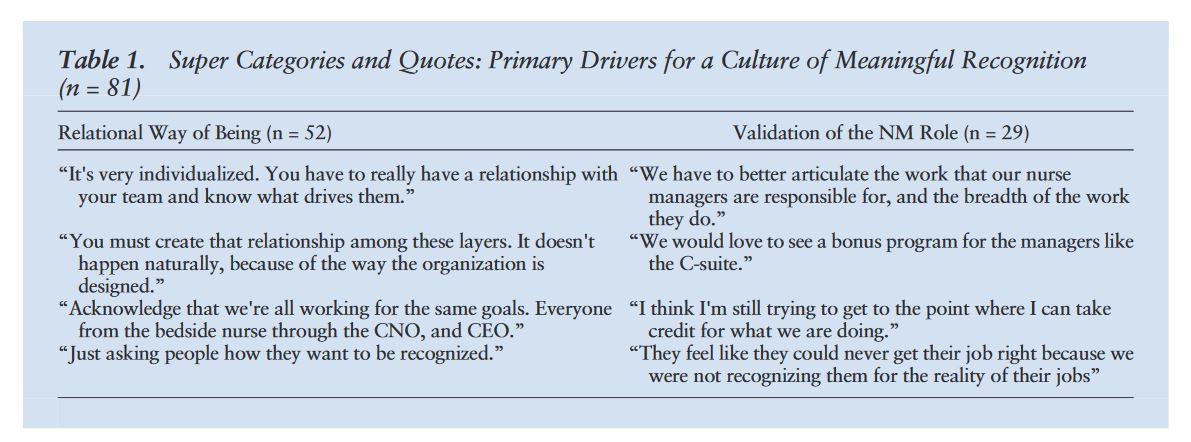
“Nurse recognition has been viewed as a critical component of a healthy work environment. The American Association of Critical-Care Nurses (AACN) describes elements of meaningful recognition, including a formal process from the organization that has structured and
sustainable processes for recognizing the contributions of individuals. In this sense, meaningful recognition includes identifying and honoring the value a nurse brings to the organization. Nurses who feel recognized have higher compassion satisfaction and lower burnout and describe feelings of gratitude, respect, and appreciation from their patients.” (Joseph)

Joseph

Joseph, M. L., Kelly, L., Davis, M. B. H., Zimmermann, D., & Ward, D. (2023). Creating an Organizational Culture and Climate of Meaningful Recognition for Nurse Managers. JONA: The Journal of Nursing Administration, 53(7/8), 370–377

Continue reading

Emory Authors: Burned Out on Burnout

“Fifty-six percent of nurses in a national sample reported burnout symptoms in 2022. Although the nursing literature on burnout dates back to 1978, nurses and other health professionals continue to grapple with this workplace phenomenon that leads to deleterious outcomes, including suicide. The suicide risk among US nurses now surpasses that of physicians. Stories of nurses who have died by suicide or considered it are emerging, and some are similar to this suicide note titled, “A Letter to My Abuser,” which was published as a letter to the editor from the nurse’s parents. More attention is needed to meaningfully address nursing burnout and this can be done by also using an equity lens.”

Continue reading

JONA Highlights: No more unimplementable nurse workforce planning.

“Mathematical Programming (optimisation) (MP)-based nursing research has been published for nearly thirty years almost exclusively in industrial engineering or health business administration journals, demonstrating a widening gap between nursing research and practice. Nurse scientists’ knowledge and skill of MP is insufficient, as are their interdisciplinary collaborations, setting back the advancement of nursing science. Above all, nurse scientists skilled in decision science are desperately needed for that analytic intellection which is rooted in the intrinsic nature and value of nursing care. It is imperative that nurse scientists be well-prepared for the new age of the Fourth Industrial Revolution through both an education in MP and interdisciplinary collaboration with decision science experts in order to prevent potential stereotyped MP-based algorithm-driven destructive influences.
The current global nursing shortage makes optimal nursing workforce staffing and scheduling more important. MP helps nurse executives and leaders to ensure the most efficient number of nurses with the most effective composition of nurse staffing at the right time for a reasonable cost. Nurse scientists urgently need to produce a new nursing knowledge base that is directly implementable in nursing practice.” (Park)

Continue reading

Emory Authors: Reimagining the Preceptor Role.

“Preceptors are responsible for departmental specific orientation and shaping the development of the new graduate in the early weeks and months of their nursing career. Turnover of direct care nurses has increased at an alarming rate since the start of the pandemic and new graduate nurses continue to be in high demand, but the diminishing number of qualified preceptors presents a challenge. Innovative approaches are needed to make way for increasing the pace of hiring and onboarding new graduates. A group orientation approach was identified as an opportunity to re-design orientation for newly licensed registered nurses in an employer-based transition to practice nurse residency programs. Findings from the first cohort suggest that leaders, preceptors, direct care nurses, and new graduate orientees were satisfied with a group orientation model. Preparing novice nurses to enter practice requires organizational commitment and resources. Group orientation may be a useful approach to foster new graduate nurses’ transition to practice and advance the preceptor role.” (McDermott)

Continue reading