JONA Highlights: Addressing the Shortage of Academic Nurse Educators-An Opportunity for Collaboration Between Academic and Healthcare Organization Leaders.

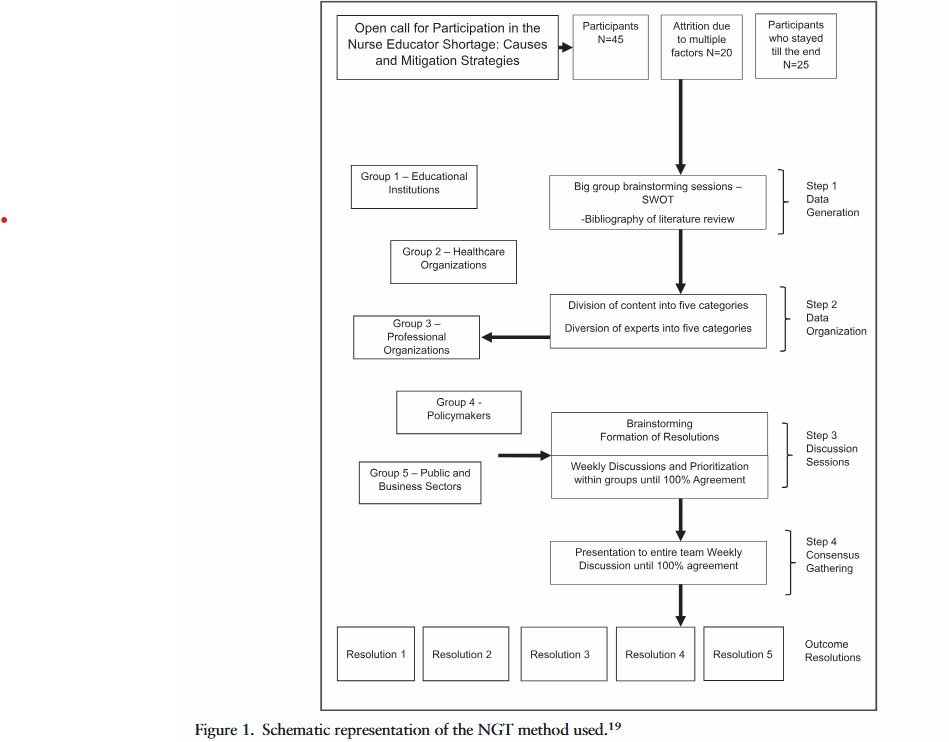
“The nursing shortage is not new; however, it has been exacerbated by burnout, mass resignations, and alternative employment options during the COVID-19 crisis. A reported lack of academic nurse educators (ANEs) and impending shortages are predicted to have a negative impact on the nursing workforce. Academic nurse educators are licensed RNs with an advanced degree, typically a master’s in nursing, a doctorate of nursing practice, an EdD, or a PhD, and employed by a university, college, or school of nursing. The dearth of ANEs has led nursing programs to cap the number of accepted students, contributing to the nursing shortage. According to the National League for Nursing, the faculty shortage
across all nursing programs has almost doubled from 669 vacancies3 in 2019 to 1005 vacancies in 2022.”

Continue reading

Library Resources for Emory Healthcare Staff

Access to library resources has recently been updated bring universal access across EHC, including the EDOU locations.

You can view the available resources at this link: Resources for Emory Healthcare Staff

You can also visit our LibGuide Library Resources for Emory Healthcare Staff. This includes additional resources including tutorials and guides.

New Nursing Continuing Education Page

The WHSC Library is committed to providing Emory students, faculty, and healthcare professionals with the resources necessary to prepare for specialty certification exams, license renewal and achieve advancements in your career.

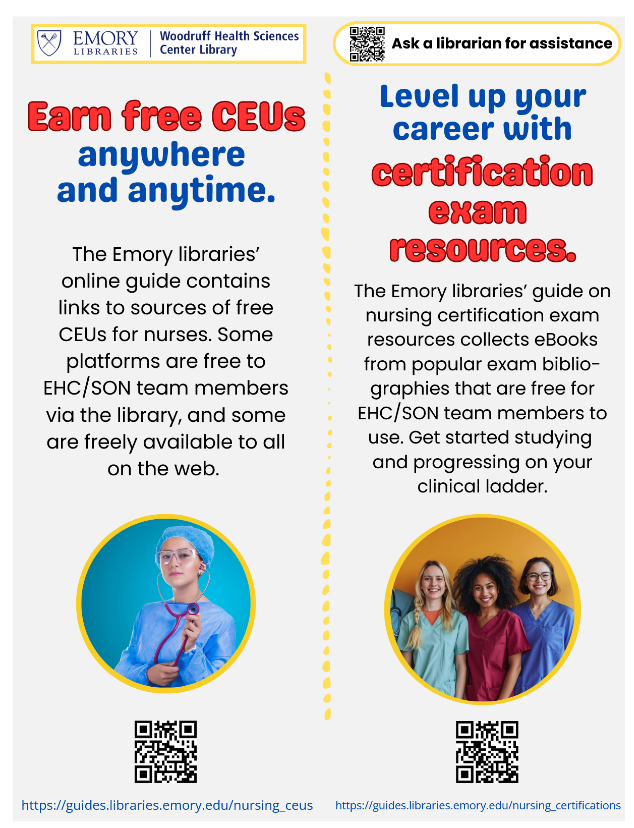
To help support your continuing education and professional development, a new online Nursing Continuing Education guide from the WHSC Library links nurses from Emory Healthcare and the School of Nursing to sources of both free and library-subscribed nursing CEUs to help with license renewal.

This guide, along with the Nursing Certification Resources page, support our Emory healthcare communities and their dedication to patient care and safety.

Nurse Certification Resources: Emory University’s Woodruff Health Sciences Library

*See Notification below*

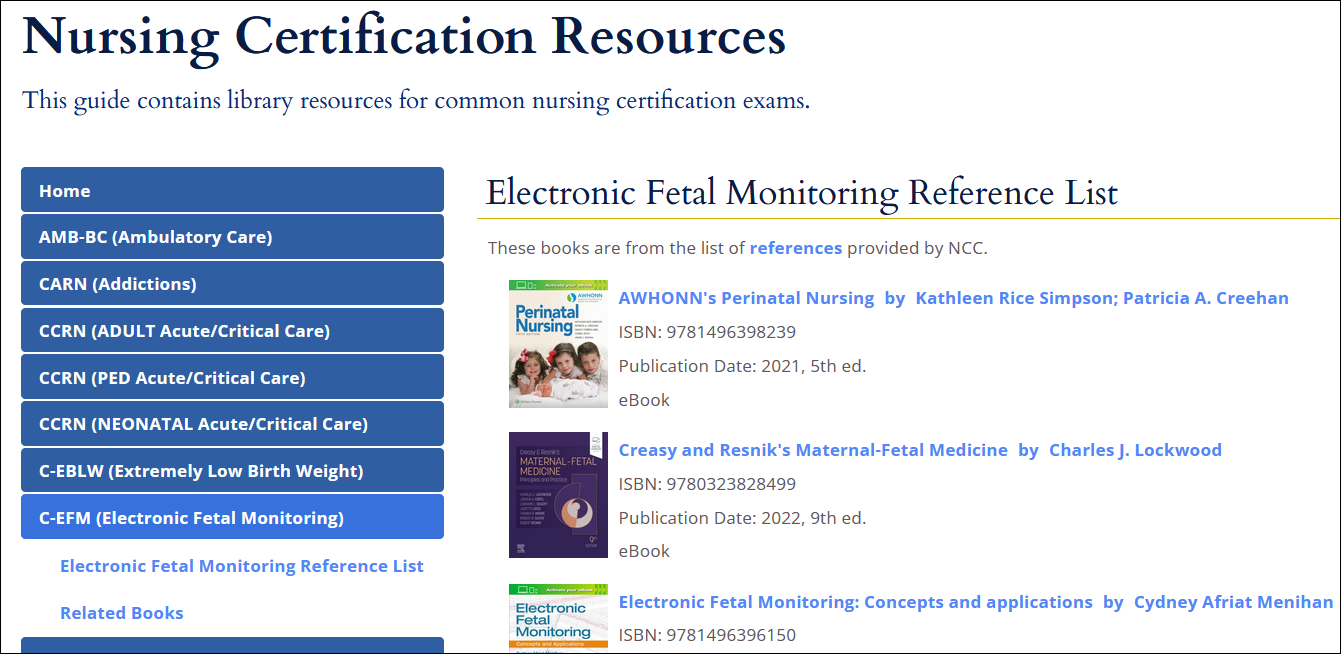
The WHSC Library supports our nursing populations in attaining advanced nursing specialty certifications. Specialty certifications recognize nurses’ skills and knowledge, improve quality of care and health outcomes, and support Magnet status.

Our new online guide helps nurses advance their careers by providing access to reference books that are used for common nurse certification exams. At this guide you’ll find an extensive list of certifications and lists of reference books that are available through Emory Libraries. We hope that you’ll find this to be a helpful resource during your studies!

*Not all materials will be accessible with EHC credentials*

Please visit the WHSCL or one of the Clinical Branch Libraries for access.

Emory University Hospital 
Room H-140, EUH
Phone:  404-727-5192 

Emory University Hospital Midtown 
1st Floor, Room 1312, Davis-Fischer Building
Phone:  404-686-1978

Emory John’s Creek Hospital 
Education Room, Ground Floor
Phone: 404-686-1978

Emory Saint Joseph’s 
Ground Floor Classrooms

Emory Authors: Implementing Cognitive Rehearsal Training With Nursing Students to Counter Incivility in the Clinical Setting as Students and New Nurses.

“Incivility is prevalent in the clinical workplace and can lead to reduced self-confidence, adverse health effects, and negative implications for patient care. Cognitive rehearsal training (CRT) serves as a mental plan that individuals can use to counter incivility. This mixed-methods study examined select outcomes related to experiencing incivility for nursing students before and after receiving CRT and early into their professional practice. Many participants described experiencing incivility. Most found CRT useful and implemented the general approach of pausing and thinking before responding. Incorporating CRT into prelicensure education has potential for decreasing the effects of incivility and protecting professional well-being.”

“COGNITIVE REHEARSAL TRAINING Following the training structure developed by Griffin (2004), CRT included one hour of didactic presentation on incivility and its consequences and one hour of interactive small-group role-play, during which participants practiced first
pausing after experiencing an uncivil remark or gesture and then utilizing a scripted response to address the incivility. The pause mitigates emotional reaction, and the use of a scripted response reduces cognitive burden in the moment.”

“SIMULATION-BASED LEARNING EXPERIENCE Students participated in the SBLE one to three weeks following CRT. The objectives of the SBLE were for students to work in small groups to provide care to multiple patients, recognize incivility, and utilize CRT strategies to
deflect incivility. The SBLE was designed following standards of best practice for simulation by a certified health care simulation educator.”

Continue reading

Emory Authors: Reject the “Practice Readiness Myth”

“The nursing profession is engaged in robust national dialogue on how to implement competency-based education. This dialogue often conflates the concept of “competency-based education” with nursing “competence” or “practice readiness.” Our aim is to discuss the potential harms of conflating “competency-based education” with “competence” or “practice readiness.” This commentary explores the possible risks of issue conflation. Risks include (a) suggesting that nurses who have successfully obtained licensure are not “competent” or “ready to practice,” and (b) de-emphasizing the importance of safe and sustainable work environments for new graduate nurses. We discuss the need to separate conversations about “competency-based education” and “practice readiness”; the need to increase the clarity and specificity of discourse surrounding competency-based education; and the need for strategic alignment across academia and practice.”

Continue reading