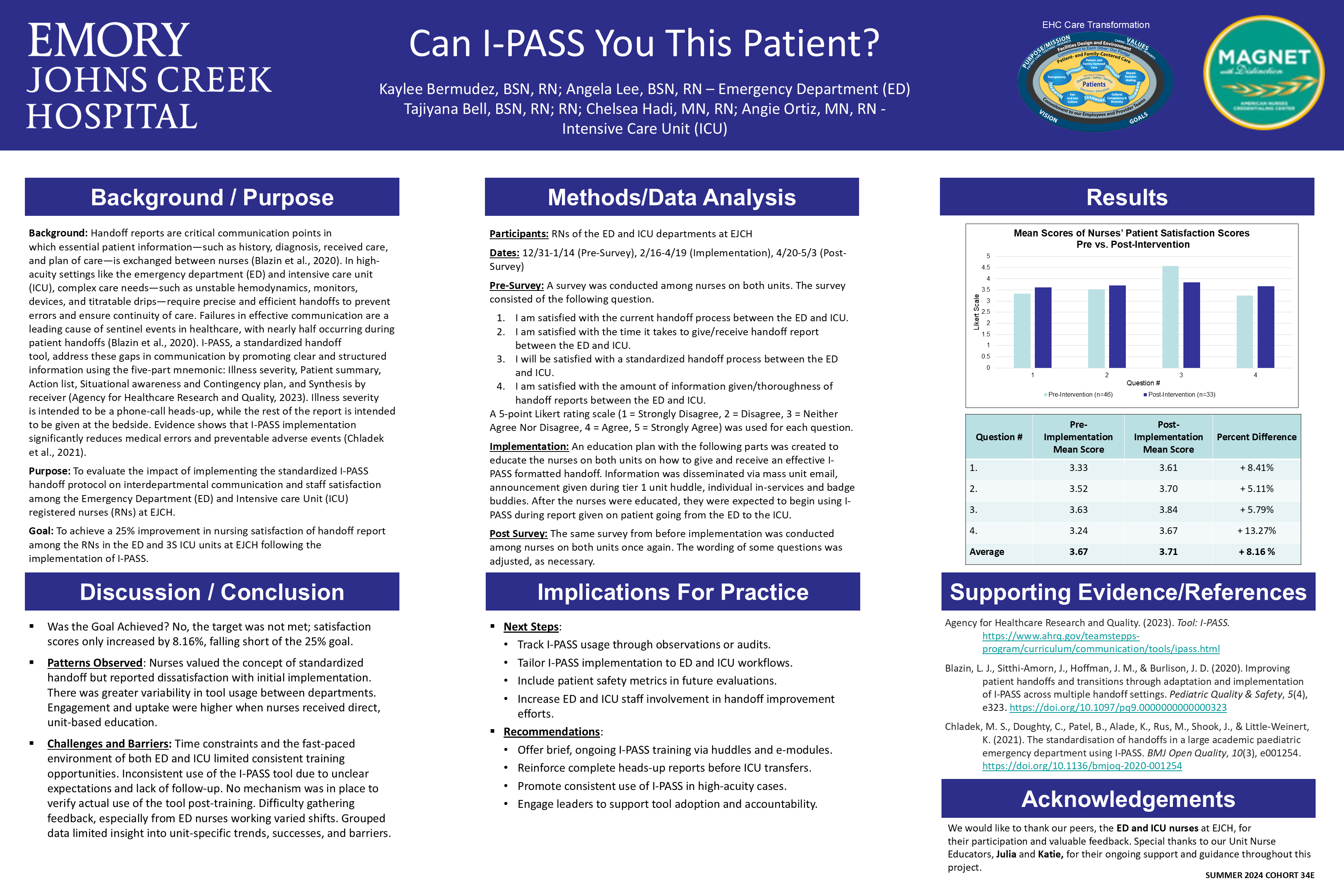
Can I-PASS You This Patient?
Reply

“Retaining high-quality, healthy, and well-educated nurses is vital to health systems’ capacities to provide patients with safe and evidence-based care. Research consistently demonstrates the benefits to patient safety when hospitals are adequately staffed with qualified nurses. Yet, estimates show over one-third of nurses have expressed some intention to leave their jobs and that approximately 1 in 5 nurses leave their jobs annually.
In the Southeastern United States, nurse turnover and intent to leave are particularly acute relative to elsewhere in the nation. The COVID-19 pandemic exacerbated working conditions for many nurses, accelerating trends with increasing numbers of nurses leaving, or planning to leave their positions, and even the profession. Identifying scalable approaches to promote workplace well-being and foster nurse retention is urgently needed
to stymie continued losses to the nurse workforce.”
Access to library resources has recently been updated bring universal access across EHC, including the EDOU locations.
You can view the available resources at this link: Resources for Emory Healthcare Staff
You can also visit our LibGuide Library Resources for Emory Healthcare Staff. This includes additional resources including tutorials and guides.
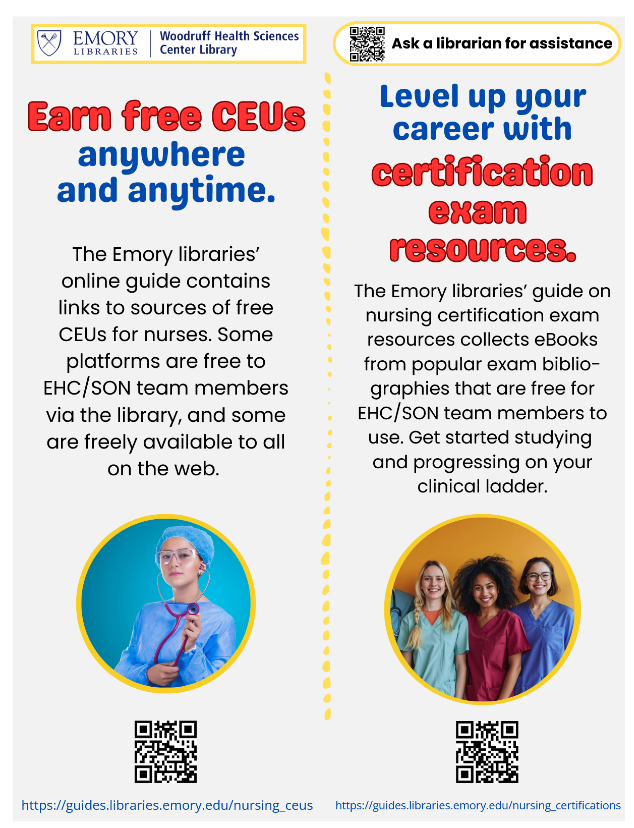
“The complete impact of skin disease on patients represents a sum of disease impacts in multiple domains, including symptom, emotional, and functional impacts. These domains
define the patient’s illness experience, which can be different from what physicians perceive when they examine the skin. Consistently capturing and quantifying disease impact in individual patients in routine clinical dermatology practice are difficult. Measures of disease activity, when captured in dermatology practice, tend to focus on objective measures such as skin erythema and scale or body surface area involved. Skin symptom burden may not readily be observed by clinicians, resulting in underestimating skin disease burdens.”
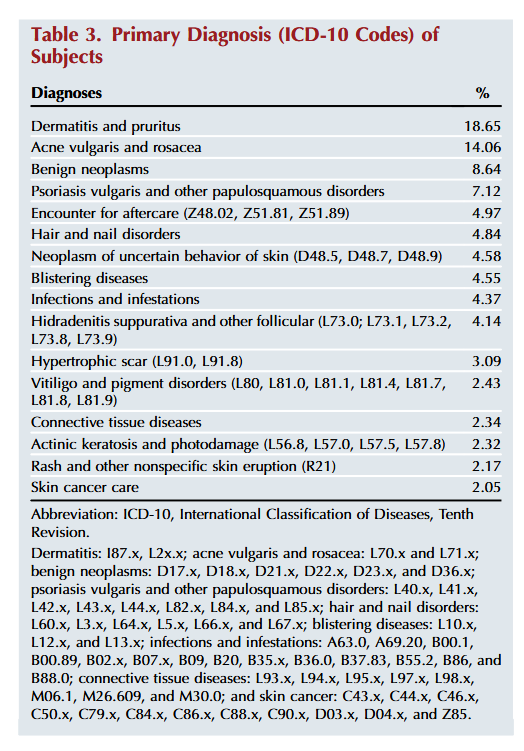
The WHSC Library is committed to providing Emory students, faculty, and healthcare professionals with the resources necessary to prepare for specialty certification exams, license renewal and achieve advancements in your career.
To help support your continuing education and professional development, a new online Nursing Continuing Education guide from the WHSC Library links nurses from Emory Healthcare and the School of Nursing to sources of both free and library-subscribed nursing CEUs to help with license renewal.
This guide, along with the Nursing Certification Resources page, support our Emory healthcare communities and their dedication to patient care and safety.
“Premature infants have an underdeveloped epidermal barrier with few cornified layers increasing their risk for greater permeability by noxious agents, high water loss, delayed skin maturation, skin damage, and infection. Their skin is easily torn due to deficiency of dermal structural proteins. Stratum corneum (SC) maturation is rapid upon exposure to a dry environment. At 23 weeks, it is nearly absent, with transepidermal water loss (TEWL) of
75 g/m 2 /h. By week 26, a few cornified layers have formed (TEWL of ~45 g/m 2/h), corresponding essentially to a wounded skin surface. One month later, premature SC was not fully competent, as indicated by significantly higher TEWL (17 g/m 2 /h) than normal, full-term infants. Complete skin maturation may take as long as 9 weeks and longer for complete acid mantle formation.”

Visscher, M. O., Carr, A. N., & Narendran, V. (2021). Premature infant skin barrier maturation: status at full-term corrected age. Journal of Perinatology, 41(2), 232–239.
Continue reading*See Notification below*
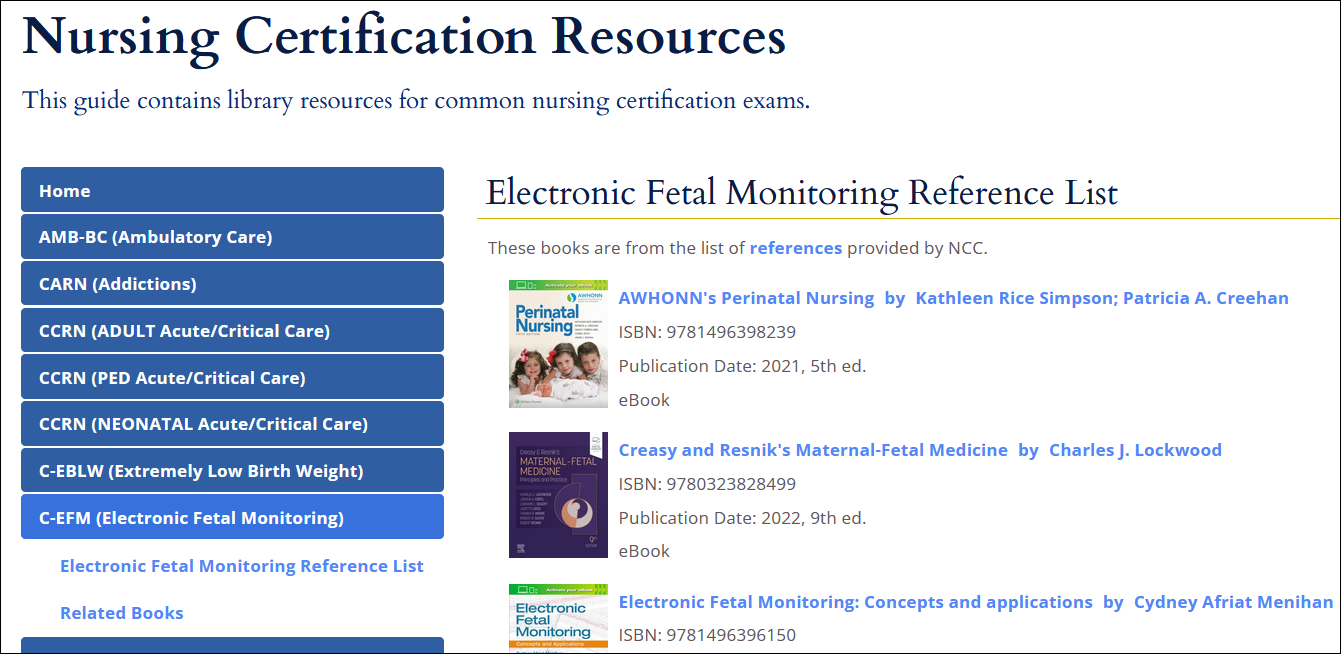
The WHSC Library supports our nursing populations in attaining advanced nursing specialty certifications. Specialty certifications recognize nurses’ skills and knowledge, improve quality of care and health outcomes, and support Magnet status.
Our new online guide helps nurses advance their careers by providing access to reference books that are used for common nurse certification exams. At this guide you’ll find an extensive list of certifications and lists of reference books that are available through Emory Libraries. We hope that you’ll find this to be a helpful resource during your studies!
*Not all materials will be accessible with EHC credentials*
Please visit the WHSCL or one of the Clinical Branch Libraries for access.
Emory University Hospital
Room H-140, EUH
Phone: 404-727-5192
Emory University Hospital Midtown
1st Floor, Room 1312, Davis-Fischer Building
Phone: 404-686-1978
Emory John’s Creek Hospital
Education Room, Ground Floor
Phone: 404-686-1978
Emory Saint Joseph’s
Ground Floor Classrooms
 Evidence Matters