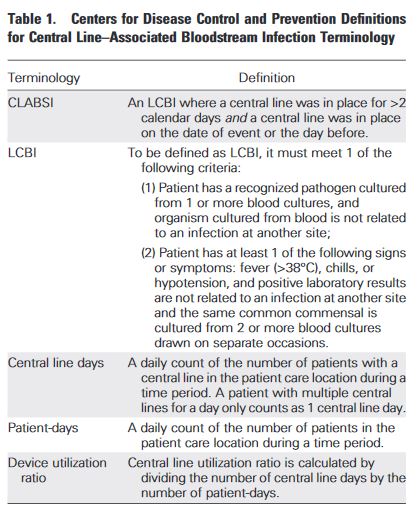
What are effective interventions to decrease CLABSIs in the long term acute care population?

This systematic review and meta-analysis examines the impact of quality improvement interventions on central line–associated bloodstream infections in adult intensive care units. Studies were identified through Medline and manual searches (1995–June 2012). The results suggest that quality improvement interventions contribute to the prevention of central line–associated bloodstream infections. Implementation of care bundles and checklists appears to yield stronger risk reductions.

Continue reading

Do oncology nurse-navigators (ONN) improve patient outcomes?

Muñoz R, et al.. Multidisciplinary Cancer Care Model: A Positive Association Between Oncology Nurse Navigation and Improved Outcomes for Patients With Cancer. Clin J Oncol Nurs. 2018 Oct 1;22(5):E141-E145.

Muñoz R, Farshidpour L, Chaudhary UB, Fathi AH. Multidisciplinary Cancer Care Model: A Positive Association Between Oncology Nurse Navigation and Improved Outcomes for Patients With Cancer. Clin J Oncol Nurs. 2018 Oct 1;22(5):E141-E145. doi: 10.1188/18.CJON.E141-E145. PMID: 30239520.
Fulltext for Emory Users

Continue reading

Understanding the importance of timely ECG in the Emergency Department.

ST-segment elevation myocardial infarction (STEMI) is a life-threatening disease that can result in irreversible myocardial damage when untreated. Delays in treatment, on the order of minutes are associated with increased mortality and worsening cardiac functional outcomes.To facilitate rapid treatment, international guidelines recommend that out-of-hospital clinicians refer patients with symptoms suggestive of STEMI to an emergency department directly or via emergency medical service(EMS) transport.These guidelines recommend the acquisition and diagnostic interpretation of an ECG within 10 minutes of emergency department (ED) arrival.”

Continue reading

Reducing racial and ethnic disparities in healthcare

“Reduction of health disparities and advancement of health equity in the United States require high-quality data indicative of where the nation stands vis-à-vis health equity, as well as proper analytic tools to facilitate accurate interpretation of these data.Although much is understood about the role of social determinants of health in shaping the health of populations, researchers should continue to advance understanding of the pathways through which they operate on particular health outcomes. There is still much to learn and implement about how to measure health disparities, health inequities, and social determinants of health at the national level, and the challenges of health equity persist.”

Penman-Aguilar A, Talih M, Huang D, Moonesinghe R, Bouye K, Beckles G. Measurement of Health Disparities, Health Inequities, and Social Determinants of Health to Support the Advancement of Health Equity. J Public Health Manag Pract. 2016 Jan-Feb;22 Suppl 1(Suppl 1):S33-42.

Continue reading

What are the considerations for experienced nurses transitioning to practice?

“Global workforce shortages and rising healthcare demands have encouraged registered nurses to move into new clinical settings. While a body of literature reports on the transition of newly qualified nurses, evidence surrounding the transition of more experienced registered nurses to new clinical areas remains poorly explored. There is some evidence to highlight the initial shock and emotional stress experienced by registered nurses during transition to a new clinical area. However, the influence of formal and informal support systems for such registered nurses is far from conclusive. Further research is needed, to examine registered nurse transition into a variety of clinical areas to inform workforce support, policy and practices.”

Continue reading

What factors lead to resilient healthcare teams?

Psychological resilience, “the human ability to adapt in the face of tragedy, trauma, adversity, hardship, and ongoing significant life stressors,”[1] is thought to be a state of internal balance where “we are at our best, able to learn, solve problems, and work effectively with others”, resulting in better patient outcomes, and less employee burnout and turnover.[2]

Leadership techniques for team resilience training have been researched. One study found that managers addressed difficult situations by “facilitating teamwork through goalsetting, problem-solving and circumventing the technical systems’ limitations”, noting that increased team collaboration is supported by “team members’ abilities to predict the behavior of each other.”[3] Other strategies include “those that: a) foster connections within the team; b) provide education and training to develop behaviors that assist in controlling or limiting the intensity of stress, or aiding recovery; and c) assist in processing emotion and learning from experiences.”[4]

Additionally, in workshops, medical residents found greater personal strength from the group experience when they reflected on difficult cases and discussed them as a group, along with reviewing the “4 S’s” of resilience (Supports, Strategies, Sagacity [what wisdom did they gain], and Solutions to the problem).[5]

Resiliency is a factor for team success outside of healthcare as well. A Harvard Business Review survey[6] of 2,000 National Collegiate Athletic Association (NCAA) basketball coaches found that,

The “characteristics of a resilient team are:

  • They believe they can effectively complete tasks together.
  • They share a common mental model of teamwork.
  • They are able to improvise.
  • They trust one another and feel safe.”
Continue reading