What methods can minimize distractions during medication preparation in the acute care hospital setting?

A QI initiative aimed at reducing the number of interruptions and distractions experienced by nurses during the medication administration process examined the effects of:

  • introduction of a medication administration room
  • standardization of the medication administration process

These changes in practice had significant impact, resulting in “an 88.5% reduction in distractions and interruptions.[1]”
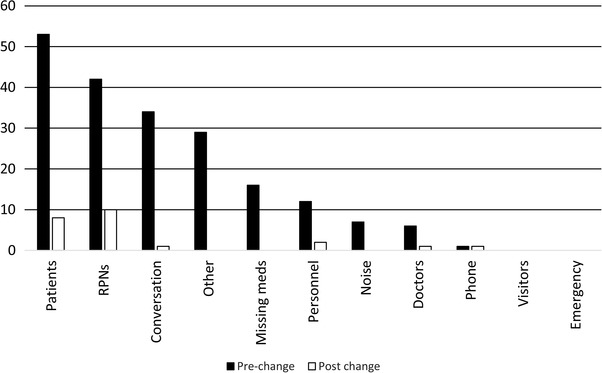
Number of distractions or interruptions per source pre- and postimplementation of practice change.

Kavanagh A, Donnelly J. A Lean Approach to Improve Medication Administration Safety by Reducing Distractions and Interruptions. J Nurs Care Qual. 2020 Oct/Dec;35(4):E58-E62. doi: 10.1097/NCQ.0000000000000473. PMID: 32079961.
Full text access for Emory Users.

Continue reading

What strategies can reduce alarm fatigue and false alarms in intensive care units?

“Alarms are specifically designed to cause cognitive distress and capture the attention of clinicians’ caring for multiple patients to a change warranting clinician awareness, closer assessment, and supportive intervention. In the current monitor paradigm with existing widely distributed technology, clinicians must interrupt a task when an alarm activates, identify the patient and device alarming, determine if it is actionable or non-actionable, and the type of action required. Alarm fatigue occurs when non-actionable alarms are in the majority, and clinicians develop decreased reactivity, causing them to “tune out” or ignore the alarms.”

Continue reading

How does nursing work engagement effect patient and hospital outcomes?

“The vital connection of nurse engagement to the experience of care, and ultimately to nurse and patient outcomes, is clear. Quality improvement efforts that equally emphasize initiatives to improve the patient experience and create and sustain a highly engaged nursing workforce are key to achieving desired safety and quality outcomes.”

Dempsey C, Assi MJ. The Impact of Nurse Engagement on Quality, Safety, and the Experience of Care: What Nurse Leaders Should Know. Nurs Adm Q. 2018 Jul/Sep; 42(3):278-283.

Full text for Emory users.

Continue reading

What are the barriers and facilitators to the sustainability of cancer interventions?

These overarching themes were identified, which when present, were facilitators, and if absent, were barriers:

  1. Evidence (intervention credibility, experienced efficacy, perceived need for intervention)
  2. Context (positive attitude to and capacity for survivorship/FCR care, favourable therapist orientation and flexibility, strong referral pathways)
  3. Facilitation of implementation (intervention/service fit, intervention/patient fit, and training,support, and provided resources). Continue reading

Rounding decreases call light use

PubMed collection includes 13 articles that state that rounding decreases call light use. Here’s how to access the collection.
a. Go to the Woodruff Health Sciences Center Library homepage (http://health.library.emory.edu)
b. Click on PubMed.
c. Then paste this link into your browser: https://www.ncbi.nlm.nih.gov/sites/myncbi/1HMKnKhQm_d5i/collections/52135288/public/
d. The references will appear in Pubmed. Click on a reference and you will see a Find it at Emory to the right of it-which will tell availability for full text. If you are not able to access the full text, send article citation(s) to Ask a Librarian (http://www.healthlibrary.emory.edu/about/contact/ask.php;this link is on WHSC Library homepage); our staff will get article for you and send it to you.