Restraint usage in hospitals. Practice guidelines and alternatives.

“Restraints are likely to negatively affect patients’ health and therefore a reduction in their usage is recommended for all health-care settings. To date, research on restrictive practices has concentrated on mental health and long-term care settings. To ensure restraints are used as little as possible in the acute-care hospital setting, it seems important to investigate more comprehensively the use of restraints, to include all types of restraints irrespective of ward type or subpopulations and to identify factors associated with restraint use. Restraints are often utilised in hospitals in complex care situations such as with patients at risk of falling or with delirium. When using restraints the consideration of processes like documentation and evaluation shows great potential for improvement. Standardisation of these processes and education of the interprofessional team could be beneficial for raising awareness and for the sustainable reduction of restraint use.”
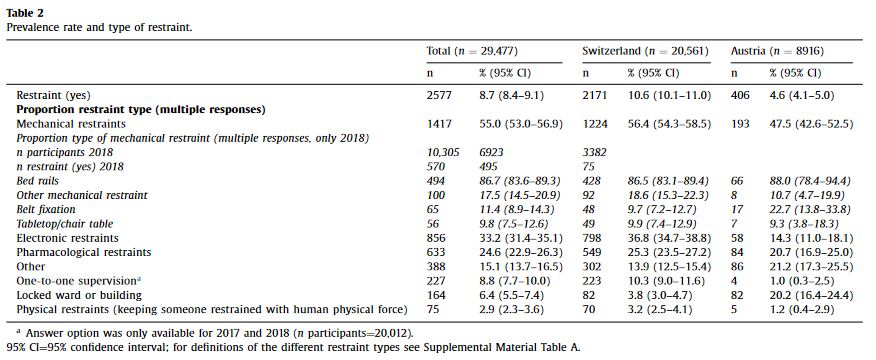
Thomann, S., Zwakhalen, Richter, Bauer, & Hahn. (2021). Restraint use in the acute-care hospital setting: A cross-sectional multi-centre study. International Journal of Nursing Studies,114, 103807.

Continue reading
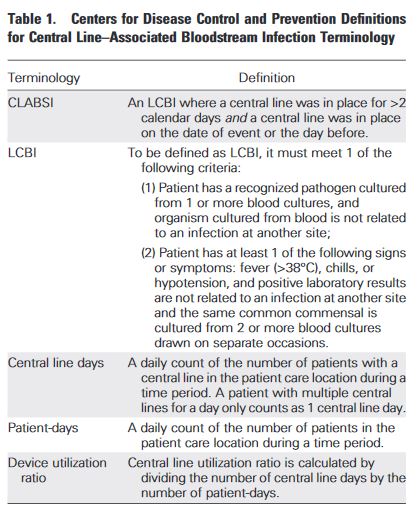
What are effective interventions to decrease CLABSIs in the long term acute care population?

This systematic review and meta-analysis examines the impact of quality improvement interventions on central line–associated bloodstream infections in adult intensive care units. Studies were identified through Medline and manual searches (1995–June 2012). The results suggest that quality improvement interventions contribute to the prevention of central line–associated bloodstream infections. Implementation of care bundles and checklists appears to yield stronger risk reductions.

Continue reading

What methods can minimize distractions during medication preparation in the acute care hospital setting?

A QI initiative aimed at reducing the number of interruptions and distractions experienced by nurses during the medication administration process examined the effects of:

  • introduction of a medication administration room
  • standardization of the medication administration process

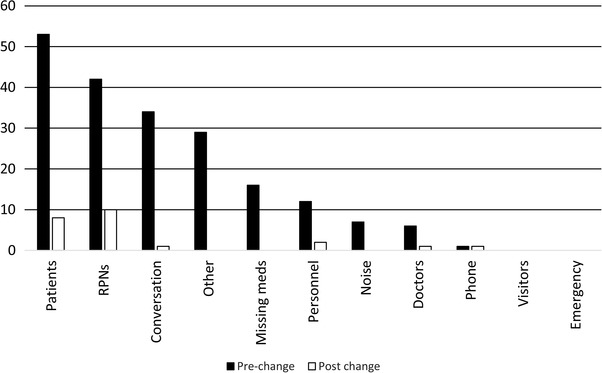
These changes in practice had significant impact, resulting in “an 88.5% reduction in distractions and interruptions.[1]”

Number of distractions or interruptions per source pre- and postimplementation of practice change.

Kavanagh A, Donnelly J. A Lean Approach to Improve Medication Administration Safety by Reducing Distractions and Interruptions. J Nurs Care Qual. 2020 Oct/Dec;35(4):E58-E62. doi: 10.1097/NCQ.0000000000000473. PMID: 32079961.
Full text access for Emory Users.

Continue reading

What strategies can reduce alarm fatigue and false alarms in intensive care units?

“Alarms are specifically designed to cause cognitive distress and capture the attention of clinicians’ caring for multiple patients to a change warranting clinician awareness, closer assessment, and supportive intervention. In the current monitor paradigm with existing widely distributed technology, clinicians must interrupt a task when an alarm activates, identify the patient and device alarming, determine if it is actionable or non-actionable, and the type of action required. Alarm fatigue occurs when non-actionable alarms are in the majority, and clinicians develop decreased reactivity, causing them to “tune out” or ignore the alarms.”

Continue reading

Prevention of surgical site infections (Updated)

“The morbidity for 2018 in the US was 157,500 for surgical site infections (SSI), with an estimated mortality of 8,205. 11% of all deaths in intensive care units were associated with SSI. It is a burden for the patient with an additional 11 days of hospitalization for each SSI and a burden to the system with an overall cost of $3.2 billion per year.”1

A collection of 50 PubMed citations has been compiled related to prevention of surgical site infections (SSIs). This material is an update to a 2018 post.

Continue reading

Communication options with patients under isolation precautions: Covid 19

Fang, J., Liu, Y. T., Lee, E. Y., & Yadav, K. (2020). Telehealth Solutions for In-hospital Communication with Patients Under Isolation During COVID-19. The western journal of emergency medicine, 21(4), 801–806. https://doi.org/10.5811/westjem.2020.5.48165

Reengineering the patient’s environment: Establishment of a “Red Box” to improve communications with patients on isolation precautions. (2019). American Journal of Infection Control : Applied Epidemiology in Health Care Settings and the Community, 47(3), 264.

Communication strategies to mitigate fear and suffering among COVID-19 patients isolated in the ICU and their families. (2020). Heart & Lung., 49(4), 344.

Fan, P., Aloweni, F., Lim, S. H., Ang, S. Y., Perera, K., Quek, A. H., Quek, H., & Ayre, T. C. (2020). Needs and concerns of patients in isolation care units – learnings from COVID-19: A reflection. World journal of clinical cases, 8(10), 1763–1766. https://doi.org/10.12998/wjcc.v8.i10.1763

McNairy, M., Bullington, B., & Bloom-Feshbach, K. (2020). Searching for Human Connectedness During COVID-19. Journal of general internal medicine, 1–2. Advance online publication. https://doi.org/10.1007/s11606-020-06082-9

Vilendrer, S., Patel, B., Chadwick, W., Hwa, M., Asch, S., Pageler, N., Ramdeo, R., Saliba-Gustafsson, E. A., Strong, P., & Sharp, C. (2020). Rapid Deployment of Inpatient Telemedicine In Response to COVID-19 Across Three Health Systems. Journal of the American Medical Informatics Association : JAMIA, 27(7), 1102–1109. https://doi.org/10.1093/jamia/ocaa077

Screening for Clostridium difficile (c. diff) before admission

Screening for Clostridium difficile colonization on admission to a hematopoietic stem cell transplant unit may reduce hospital-acquired C difficile infection. (2018). American Journal of Infection Control : Applied Epidemiology in Health Care Settings and the Community, 46(4), 459.

Effectiveness of Screening Hospital Admissions to Detect Asymptomatic Carriers of Clostridium difficile: A Modeling Evaluation. (2014). Infection Control and Hospital Epidemiology., 35(8), 1043.

Effect of Detecting and Isolating Clostridium difficile Carriers at Hospital Admission on the Incidence of C difficile Infections: A Quasi-Experimental Controlled Study. (2016). JAMA Internal Medicine., 176(6), 796.

Evolving Insights Into the Epidemiology and Control of Clostridium difficile in Hospitals. (2017). Clinical Infectious Diseases., 65(7), 1232.

Effects of a predictive preventive model for prevention of Clostridium difficile infection in patients in intensive care units. (2016). American Journal of Infection Control : Applied Epidemiology in Health Care Settings and the Community, 44(4), 421.

Interventions to Reduce the Incidence of Hospital-Onset Clostridium difficile Infection: An Agent-Based Modeling Approach to Evaluate Clinical Effectiveness in Adult Acute Care Hospitals. (2018). Clinical Infectious Diseases., 66(8), 1192.

Watkins, R. R. (2016). Screening for Clostridium difficile Carriers at Hospital Admission Reduces Subsequent C. difficile Infections. Infectious Disease Alert, 35(11), 124–125.

Maghdoori, S., & Moghadas, S. M. (2017). Assessing the effect of patient screening and isolation on curtailing Clostridium difficile infection in hospital settings. BMC Infectious Diseases, 17, 1–11