Nurse Certification Resources: Emory University’s Woodruff Health Sciences Library

*See Notification below*

The WHSC Library supports our nursing populations in attaining advanced nursing specialty certifications. Specialty certifications recognize nurses’ skills and knowledge, improve quality of care and health outcomes, and support Magnet status.

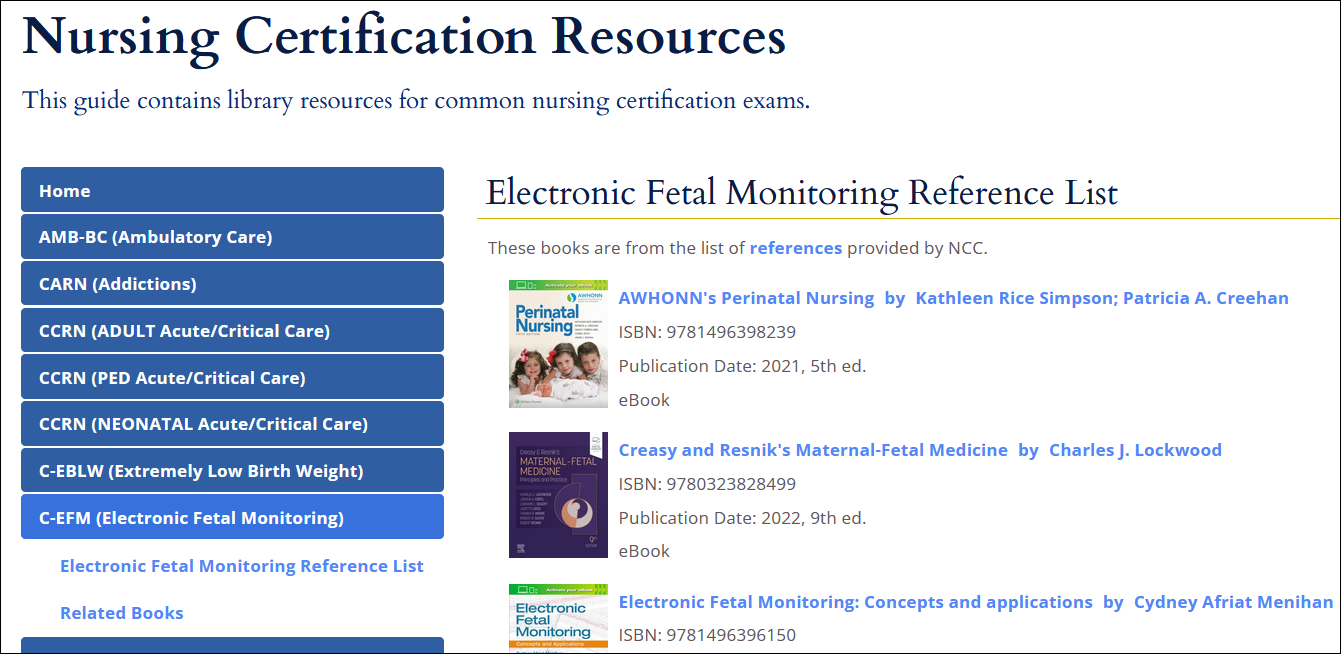
Our new online guide helps nurses advance their careers by providing access to reference books that are used for common nurse certification exams. At this guide you’ll find an extensive list of certifications and lists of reference books that are available through Emory Libraries. We hope that you’ll find this to be a helpful resource during your studies!
*Not all materials will be accessible with EHC credentials*

Please visit the WHSCL or one of the Clinical Branch Libraries for access.

Emory University Hospital 
Room H-140, EUH
Phone:  404-727-5192 

Emory University Hospital Midtown 
1st Floor, Room 1312, Davis-Fischer Building
Phone:  404-686-1978

Emory John’s Creek Hospital 
Education Room, Ground Floor
Phone: 404-686-1978

Emory Saint Joseph’s 
Ground Floor Classrooms

Emory Authors: Confidence, commitment, and control: Nursing faculty experiences with teaching LGBTQ+ health

“Nursing education research demonstrates that lesbian, gay, bisexual, transgender and queer (LGBTQ+) health receives scant attention in nursing curricula. The American Nurses Association (ANA) advocates for “Nurse educators that will help fill the void in knowledge by incorporating the issues of the LGBTQ+ populations as part of the curricula”. Calls to
action from scholars and professional nursing organizations demonstrate that while nurse educators are responsible for including LGBTQ+ related content in nursing curricula, these topics are not adequately suffused into nursing training.”

Continue reading

Drills for low frequency, high acuity events

“Patient outcomes during crisis events directly link to healthcare providers’ swift and appropriate actions, with nurses often the first responders to crisis events within the hospital. Crisis events, such as rapid responses and cardiac arrests, can prompt staff fear and anxiety regardless of years of professional experience, leading to hesitation and low self-confidence in decision-making. To optimize patient outcomes in crisis events, nursing staff should identify a decompensating patient quickly and begin competently performing resuscitation tasks. Previous mock code studies have found alarming delays in resuscitation tasks and overall poor performance; recommendations often discuss the need to focus on the first responders and the tasks being completed before the code team’s arrival Thus, the most critical period of the resuscitation process is left in the hands of nursing staff as first responders.

Bennett, J., et al (2021). Optimizing Nursing Response to Crisis Events through In-Situ Simulation. Medsurg Nursing, 30(2), 108-114.

Continue reading

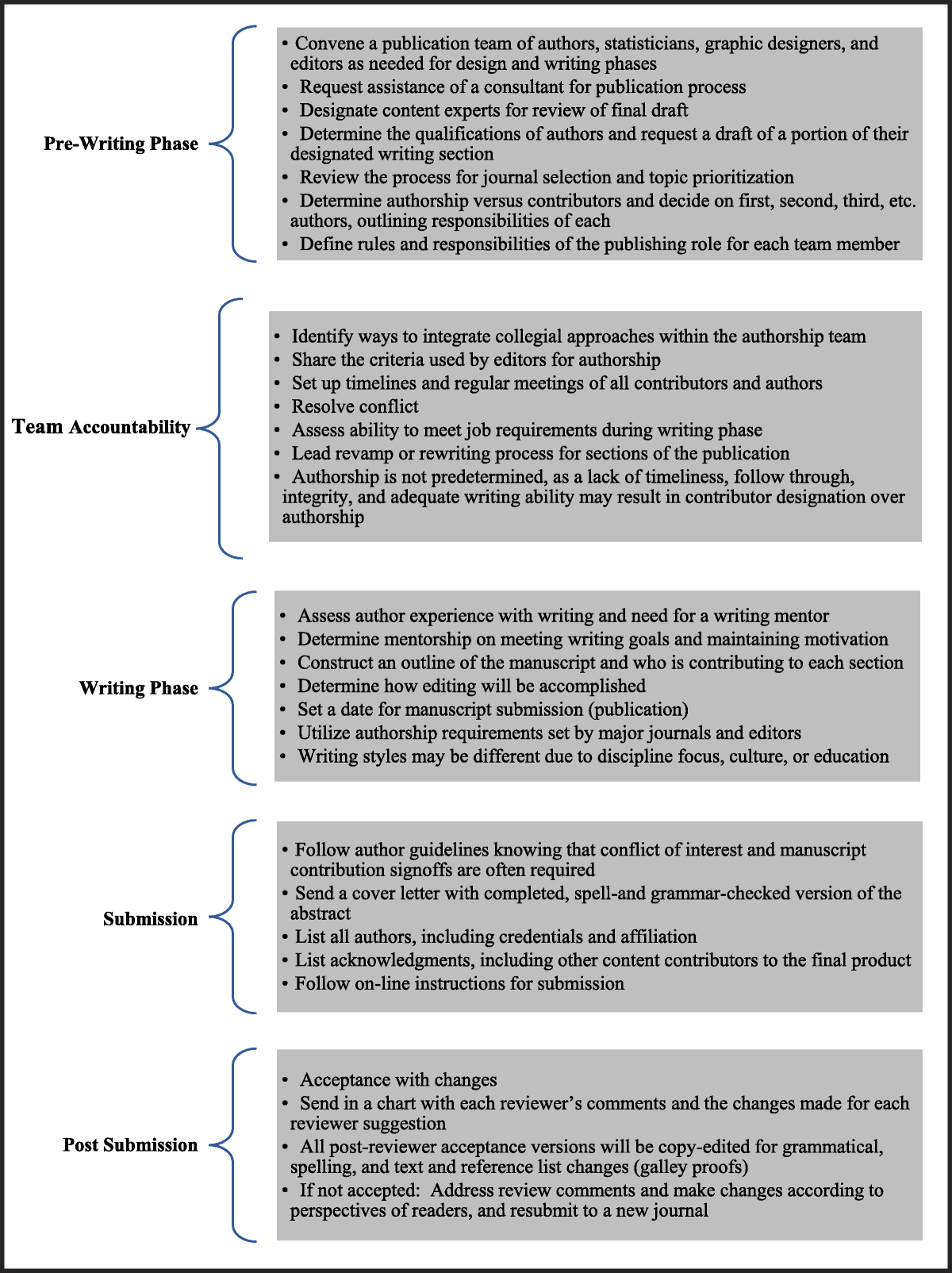
JONA Highlights: Practical Steps Supporting Professional Publications for Leadership and Teams

“Disseminating research or evidence-based practice is not straightforward. As more clinical nurses, executive nurse leaders, nurse scientists, and faculty contribute to new knowledge, there is an increasing need to support the processes to publish and disseminate manuscripts to advance healthcare. Nurse administrators and leaders are key influencers and supporters to bolster expertise and resources to publish. This article provides nurse leaders and administrators clear, actionable steps to enable successful publication outcomes”

Continue reading

Emory Authors: Implementing Cognitive Rehearsal Training With Nursing Students to Counter Incivility in the Clinical Setting as Students and New Nurses.

“Incivility is prevalent in the clinical workplace and can lead to reduced self-confidence, adverse health effects, and negative implications for patient care. Cognitive rehearsal training (CRT) serves as a mental plan that individuals can use to counter incivility. This mixed-methods study examined select outcomes related to experiencing incivility for nursing students before and after receiving CRT and early into their professional practice. Many participants described experiencing incivility. Most found CRT useful and implemented the general approach of pausing and thinking before responding. Incorporating CRT into prelicensure education has potential for decreasing the effects of incivility and protecting professional well-being.”

“COGNITIVE REHEARSAL TRAINING Following the training structure developed by Griffin (2004), CRT included one hour of didactic presentation on incivility and its consequences and one hour of interactive small-group role-play, during which participants practiced first
pausing after experiencing an uncivil remark or gesture and then utilizing a scripted response to address the incivility. The pause mitigates emotional reaction, and the use of a scripted response reduces cognitive burden in the moment.”

“SIMULATION-BASED LEARNING EXPERIENCE Students participated in the SBLE one to three weeks following CRT. The objectives of the SBLE were for students to work in small groups to provide care to multiple patients, recognize incivility, and utilize CRT strategies to
deflect incivility. The SBLE was designed following standards of best practice for simulation by a certified health care simulation educator.”

Continue reading

Nursing Highlights:

“Information literacy (IL) is crucial for nursing education because it enables nursing students to effectively access, evaluate, and apply research and evidence-based practice (EBP). This includes critically assessing the quality and relevance of information sources, understanding howto effectively search for and retrieve information, and applying research and EBP to clinical decision-making.”

“Nurses who value information and scholarly inquiry will be more likely to analyze and evaluate information, identify gaps in current knowledge, and prioritize research needs to
develop EBP guidelines for safe patient care.12 By participating in EBP activities, nurses can learn how to understand and communicate research findings, which could enhance the
quality of patient care.”

Continue reading

Nurse education satisfaction scales

“Engagement with a course may improve academic performance, however, appropriate instruments are needed to measure engagement. Using an exploratory factor analysis approach, the 23-item Student Course Engagement Questionnaire (SCEQ) was used to quantify undergraduate nursing (n = 102), mid-wifery (n = 64), and paramedicine (n = 40) student engagement.” (Brown, et al)

(Brown, et al)

Brown, S., Bowmar, A., White, S., & Power, N. (2017). Evaluation of an instrument to measure undergraduate nursing student engagement in an introductory Human anatomy and physiology course. Collegian, 24(5), 491-497.
Full Text for Emory Users

Continue reading