Hot Topics: Assessing the Impact of ANCC Magnet Designation: Insights From a Chief Nursing Officer and a Magnet Program Director

“Magnet program directors (MPDs) serve as facilitators in guiding healthcare organizations through the process of attaining and sustaining Magnet designation. As architects of nursing excellence, MPDs strive to align organizational goals with Magnet standards to continually improve quality outcomes, adhere to evidence-based practices (EBPs), and foster a culture of excellence. A critical aspect of the role is the pursuit of empirical outcome measures, which reflect the impact of nursing interventions on patient care. These differ from process measures, which capture improvement efforts but not necessarily their results. Anchoring nursing practice to empirical outcomes provides context for comparing nursing-sensitive indicators against national benchmarks, a key requirement for successful designation.”

  • Evidence synthesis suggests Magnet recognition is
    associated with improved nurse work environments
    and selected patient outcomes, particularly mortality,
    failure to rescue, patient satisfaction, and fall prevention,
    while findings for infections, pressure injuries, length of
    stay, and perioperative complications are mixed.
  • Achieving Magnet status boosts the hospital’s reputa-
    tion, nurturing the hospital’s competitive edge. It con-
    tributes to the structural score in most specialties of US
    News Best Hospitals, reflecting nursing excellence as
    recognized by the ANCC.
  • Some chief financial officers suggest Magnet recognition
    may be viewed favorably by bond rating agencies as part
    of broader assessments of organizational stability.
  • Magnet hospitals can attract highly qualified and ambi-
    tious nurses, strengthening the workforce and contribut-
    ing to improved patient care.
Continue reading

JONA Highlights: Assessing the Impact of ANCC Magnet Designation

“Achieving Magnet designation is a significant milestone, but sustaining it may pose challenges. Magnet is a journey, not a destination. The journey does not end with recognition; rather, it demands ongoing readiness and leadership engagement to elevate nursing practice and improve patient outcomes. Petto et al identify the importance of leadership behaviors in sustaining quality outcomes and driving long-term success.”
“The Magnet Model provides a framework for nurse empowerment, professional development, and shared governance. Sustaining the journey fosters a positive work
environment, which leads to improved job satisfaction and lower turnover rates. Integrating Magnet principles into the organization’s strategic plan ensures that nursing initiatives align with the healthcare organization’s mission, vision, and values.”

  • “Evidence synthesis suggests Magnet recognition is associated with improved nurse work environments and selected patient outcomes, particularly mortality, failure to rescue, patient satisfaction, and fall prevention, while findings for infections, pressure injuries, length of
    stay, and perioperative complications are mixed.
  • Achieving Magnet status boosts the hospital’s reputation, nurturing the hospital’s competitive edge. It contributes to the structural score in most specialties of US News Best Hospitals, reflecting nursing excellence as recognized by the ANCC.
  • Some chief financial officers suggest Magnet recognition may be viewed favorably by bond rating agencies as part of broader assessments of organizational stability.
  • Magnet hospitals can attract highly qualified and ambitious nurses, strengthening the workforce and contributing to improved patient care”
Continue reading

New Nursing Continuing Education Page

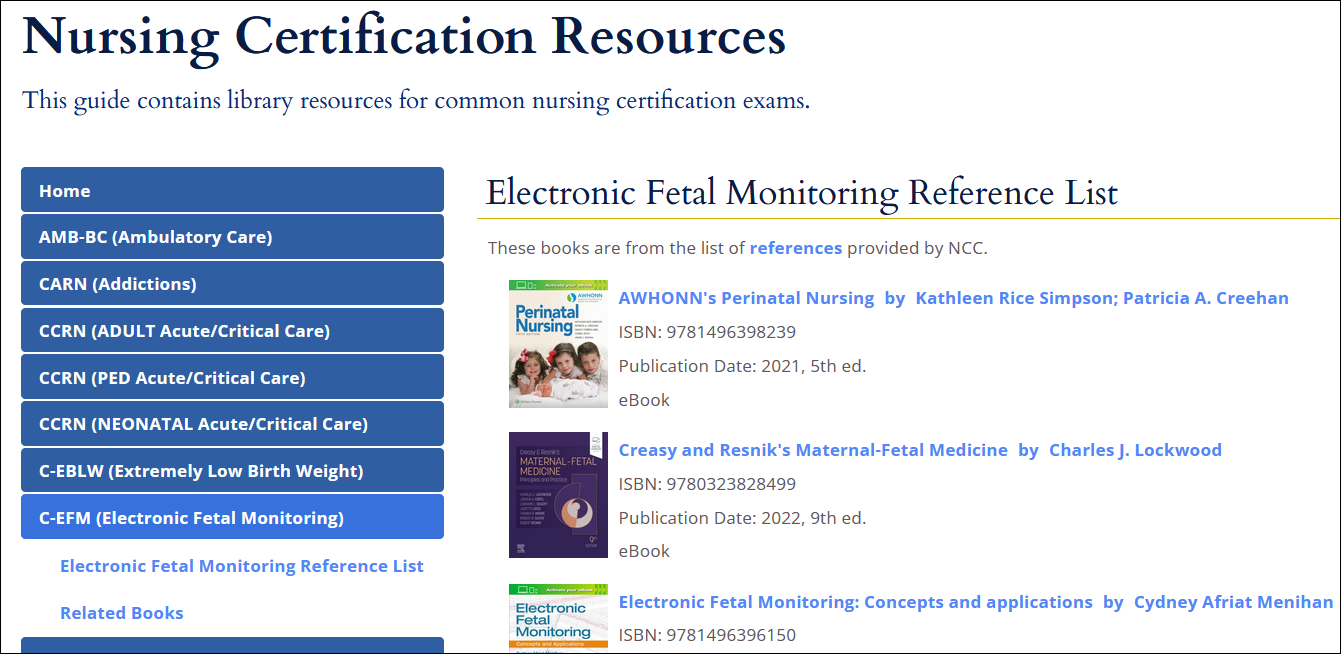
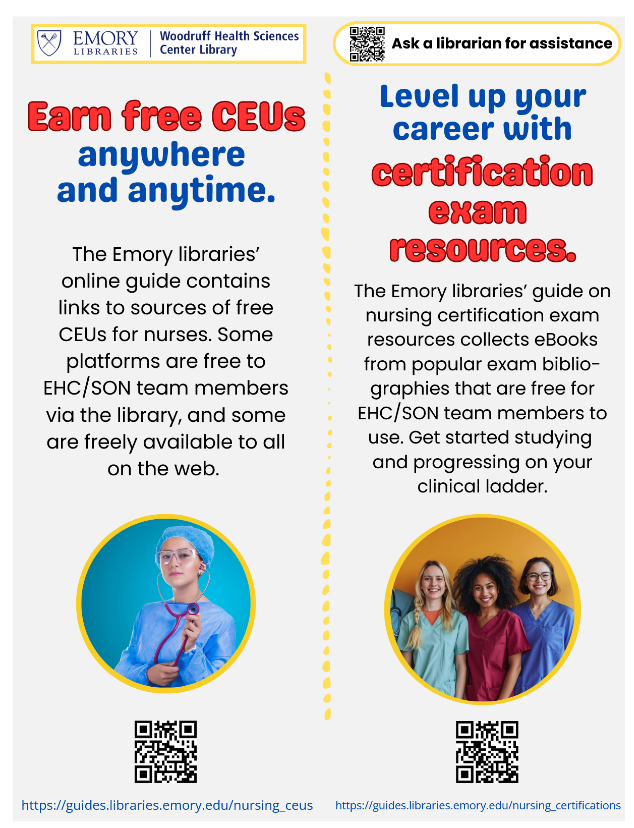
The WHSC Library is committed to providing Emory students, faculty, and healthcare professionals with the resources necessary to prepare for specialty certification exams, license renewal and achieve advancements in your career.

To help support your continuing education and professional development, a new online Nursing Continuing Education guide from the WHSC Library links nurses from Emory Healthcare and the School of Nursing to sources of both free and library-subscribed nursing CEUs to help with license renewal.

This guide, along with the Nursing Certification Resources page, support our Emory healthcare communities and their dedication to patient care and safety.

Nurse Certification Resources: Emory University’s Woodruff Health Sciences Library

*See Notification below*

The WHSC Library supports our nursing populations in attaining advanced nursing specialty certifications. Specialty certifications recognize nurses’ skills and knowledge, improve quality of care and health outcomes, and support Magnet status.

Our new online guide helps nurses advance their careers by providing access to reference books that are used for common nurse certification exams. At this guide you’ll find an extensive list of certifications and lists of reference books that are available through Emory Libraries. We hope that you’ll find this to be a helpful resource during your studies!

*Not all materials will be accessible with EHC credentials*

Please visit the WHSCL or one of the Clinical Branch Libraries for access.

Emory University Hospital 
Room H-140, EUH
Phone:  404-727-5192 

Emory University Hospital Midtown 
1st Floor, Room 1312, Davis-Fischer Building
Phone:  404-686-1978

Emory John’s Creek Hospital 
Education Room, Ground Floor
Phone: 404-686-1978

Emory Saint Joseph’s 
Ground Floor Classrooms

JONA Highlights: Exploring the Synergies Between the Magnet Recognition Program and the International Council of Nurses’ Charter for Change.

“Healthcare organizations across the globe apply the Magnet® Model framework to achieve excellence in nursing practice, thriving work environments, and improved patient, nursing, and organizational outcomes. The International Council of Nurses’ (ICN) Charter for Change (2023) commissioned actionable measures for change to advance the nursing profession into the future. This article explores the synergies between the Magnet Recognition Program® and the ICN Charter for Change, aiming to demonstrate that integrating the principles of both models can provide a roadmap for healthcare organizations to enhance
nursing professional development, foster a culture of innovation and evidence-based practice, and ultimately improve healthcare outcomes for patients and communities globally.”

Continue reading

JONA Highlights: The Magnet Recognition Program and its Influence on Hospital Rankings

“The significance of ANCC Magnet recognition and its positive impact on global safety, quality, mortality rates, patient experience, nurse empowerment, satisfaction, and retention are consistently increasing. There are currently approximately 612Magnet-designated organizations, approximately 10% of US hospitals. The Magnet designation is not easily achieved, requiring rigorous assessment of an organization’s nursing practices, patient care models, and outcomes in the top benchmarks.”

Continue reading