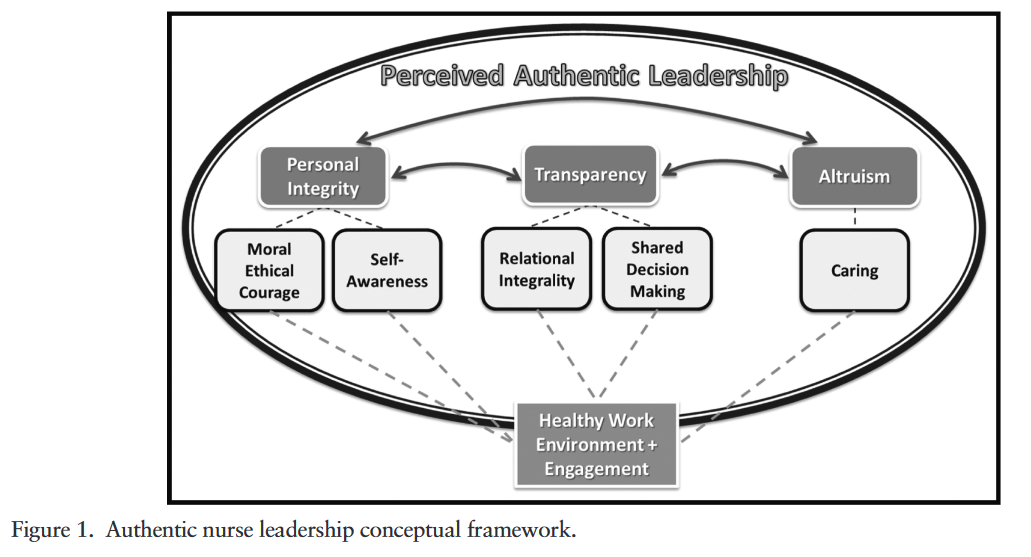
“This study aimed to develop and validate a tool to measure authentic nurse leadership (ANL) from the perspective of nurse leaders.” (Giordano-Mulligan)

“This study aimed to develop and validate a tool to measure authentic nurse leadership (ANL) from the perspective of nurse leaders.” (Giordano-Mulligan)

The Use of Technology
“Now more than ever, health systems must protect nurses from spending time on work that falls outside of core nursing responsibilities.9 Technology can make life easier for medical professionals and patients alike. It can help relieve the burden on the clinical nurse by enabling some responsibilities to be automated and more expedient, freeing time for nurses to prioritize more critical patient needs. There are numerous innovative technologies leaders should consider integrating into nurse workflow so care teams can think and work in new ways. Examples include the following:

“Engagement with a course may improve academic performance, however, appropriate instruments are needed to measure engagement. Using an exploratory factor analysis approach, the 23-item Student Course Engagement Questionnaire (SCEQ) was used to quantify undergraduate nursing (n = 102), mid-wifery (n = 64), and paramedicine (n = 40) student engagement.” (Brown, et al)

Brown, S., Bowmar, A., White, S., & Power, N. (2017). Evaluation of an instrument to measure undergraduate nursing student engagement in an introductory Human anatomy and physiology course. Collegian, 24(5), 491-497.
Full Text for Emory Users
“Nursing leaders responsible for orientation are challenged by the plethora of nursing knowledge and clinical skills required by nurses to provide safe care to critically ill patients. The goal is for new and experienced nurses to master the complexities of care and advanced technology and support the well-being of all. One way to achieve this goal is to actively engage new-to-practice nurses and experienced nurses in orientation programs designed to
transfer knowledge and skills needed to provide bedside care”.(Monforto)
Monforto, K., et al (2020801). Outcome-Focused Critical Care Orientation Program: From Unit Based to Centralized. Critical Care Nurse., 40(4), 54-64. Full Text for Emory Users
Continue readingPsychological resilience, “the human ability to adapt in the face of tragedy, trauma, adversity, hardship, and ongoing significant life stressors,”[1] is thought to be a state of internal balance where “we are at our best, able to learn, solve problems, and work effectively with others”, resulting in better patient outcomes, and less employee burnout and turnover.[2]
Leadership techniques for team resilience training have been researched. One study found that managers addressed difficult situations by “facilitating teamwork through goalsetting, problem-solving and circumventing the technical systems’ limitations”, noting that increased team collaboration is supported by “team members’ abilities to predict the behavior of each other.”[3] Other strategies include “those that: a) foster connections within the team; b) provide education and training to develop behaviors that assist in controlling or limiting the intensity of stress, or aiding recovery; and c) assist in processing emotion and learning from experiences.”[4]
Additionally, in workshops, medical residents found greater personal strength from the group experience when they reflected on difficult cases and discussed them as a group, along with reviewing the “4 S’s” of resilience (Supports, Strategies, Sagacity [what wisdom did they gain], and Solutions to the problem).[5]
Resiliency is a factor for team success outside of healthcare as well. A Harvard Business Review survey[6] of 2,000 National Collegiate Athletic Association (NCAA) basketball coaches found that,
The “characteristics of a resilient team are:
Members of the Advisory Board of the Washington, DC-based Nursing Executive Center offer “5 Executive Actions to Engage Staff Amid COVID-19:
Berkow S, Virkstis K, Herleth A, Whitemarsh K, Rewers L. An Executive Strategy to Support Long-Term Clinician Engagement Amid the COVID-19 Pandemic. J Nurs Adm. 2020 Dec;50(12):616-617. doi: 10.1097/NNA.0000000000000946. PMID: 33181597.
Full text for Emory Users