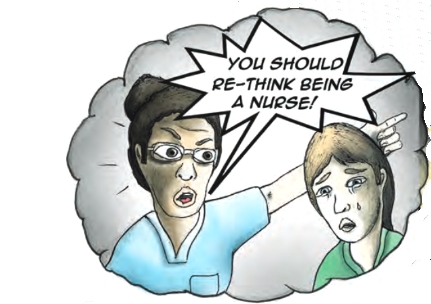
by the CRAB Project (Cognitive Rehearsal to Address Bullying).

Psychological resilience, “the human ability to adapt in the face of tragedy, trauma, adversity, hardship, and ongoing significant life stressors,”[1] is thought to be a state of internal balance where “we are at our best, able to learn, solve problems, and work effectively with others”, resulting in better patient outcomes, and less employee burnout and turnover.[2]
Leadership techniques for team resilience training have been researched. One study found that managers addressed difficult situations by “facilitating teamwork through goalsetting, problem-solving and circumventing the technical systems’ limitations”, noting that increased team collaboration is supported by “team members’ abilities to predict the behavior of each other.”[3] Other strategies include “those that: a) foster connections within the team; b) provide education and training to develop behaviors that assist in controlling or limiting the intensity of stress, or aiding recovery; and c) assist in processing emotion and learning from experiences.”[4]
Additionally, in workshops, medical residents found greater personal strength from the group experience when they reflected on difficult cases and discussed them as a group, along with reviewing the “4 S’s” of resilience (Supports, Strategies, Sagacity [what wisdom did they gain], and Solutions to the problem).[5]
Resiliency is a factor for team success outside of healthcare as well. A Harvard Business Review survey[6] of 2,000 National Collegiate Athletic Association (NCAA) basketball coaches found that,
The “characteristics of a resilient team are:
Members of the Advisory Board of the Washington, DC-based Nursing Executive Center offer “5 Executive Actions to Engage Staff Amid COVID-19:
Berkow S, Virkstis K, Herleth A, Whitemarsh K, Rewers L. An Executive Strategy to Support Long-Term Clinician Engagement Amid the COVID-19 Pandemic. J Nurs Adm. 2020 Dec;50(12):616-617. doi: 10.1097/NNA.0000000000000946. PMID: 33181597.
Full text for Emory Users
Williams, F. S. (2018). New Nurse Graduate Residency Mentoring: A Retrospective Cross-Sectional Research Study. Nursing Economic$, 36(3), 121–127.
The impact of mentorship, preceptors, and debriefing on the quality of program experiences. (2019). Nurse Education in Practice., 35, 63.
Easing the Transition: An Innovative Generational Approach to Peer Mentoring for New Graduate Nurses. (2016). Journal of Pediatric Nursing., 31(6), 745.
New Nurse Practitioners’ Perceptions of Preparedness for and Transition Into Practice. (2016). The Journal for Nurse Practitioners., 12(8), 545.
Incivility, retention and new graduate nurses: An integrated review of the literature. (2014). Journal of Nursing Management., 22(6), 735.
********
Important message for Emory Decatur Nurses.
The links will not work for you. To access these articles contact the Emory Decatur Library:
Emory Decatur Hospital
Jessica Callaway (Jessica.callaway@emoryhealthcare.org
404.501.1628
Important message for Emory Decatur Nurses. The links will not work for you. To access these articles contact the Emory Decatur Library:
Emory Decatur Hospital
Jessica Callaway (Jessica.callaway@emoryhealthcare.org
404.501.1628
**********************************
Mentoring in Nursing: A Concept Analysis. (2019). International Journal of Caring Sciences., 12(1), 142.
The Nurse Leader’s Pivotal Role in Retaining Millennial Nurses. (2018). Journal of Nursing Administration., 48(12), 604.
Walking alongside: A qualitative study of the experiences and perceptions of academic nurse mentors supporting early career nurse academics. (2015). Contemporary Nurse : A Journal for the Australian Nursing Profession., 51(1), 69.
Hodges, A. (2018). Mentoring Novice Nursing Faculty; Sustaining the Next Generation. Tar Heel Nurse, 80(4), 12–17.
Case Study Investigation Decreases Burnout While Improving Interprofessional Teamwork, Nurse Satisfaction, and Patient Safety. (2019). Critical Care Nursing Quarterly., 42(1), 96.
Clinical nurses’ experiences and perceptions after the implementation of an interprofessional team intervention: A qualitative study. (2019). Journal of Clinical Nursing., 28(3/4), 430.
Page, J. S. (2016). Teams and Teamwork in Cancer Care Delivery: Shared Mental Models to Improve Planning for Discharge and Coordination of Follow-Up Care. Journal of Oncology Practice, 12(11),
Role of care pathways in interprofessional teamwork. (2016). Nursing Standard., 30(52), 42.
Multiprofessional team simulation training, based on an obstetric model, can improve teamwork in other areas of health care. (2014). American Journal of Medical Quality., 29(1), 78.
Effective followership: A standardized algorithm to resolve clinical conflicts and improve teamwork. (2015). Journal of Healthcare Risk Management : The Journal of the American Society for Healthcare Risk Management., 35(1), 21.
Novel Ideas and Team Approach to Improve Outpatient Diabetes Control in a Large Hospital System. (2018). Clinical Diabetes : A Publication of the American Diabetes Association., 36(3), 259.
van Deventer, Claire. McInerney, Patricia. Cooke, Richard.. Patients’ involvement in improvement initiatives: a qualitative systematic review. JBI Database of Systematic Reviews & Implementation Reports. 13(10):232-290, 2015.
2015
Stephenson, Matthew. Eddy, Kylie. Jordan, Zoe. Health professionals’ experience of teamwork education in acute hospital settings. Best Practice: evidence-based information sheets for health professionals. 20(11):1-5, 2018.
2018
 Evidence Matters