Emory Authors: Telemedicine impact on post-stroke outpatient follow-up in an academic healthcare network during the COVID-19 pandemic.

“Outpatient follow-up after acute stroke plays a signifcant role in optimizing patient care, secondary stroke prevention and reducing morbidity and mortality. As the risk of recurrent stroke is highest within the first six months following stroke, prompt outpatient follow-up is essential for secondary prevention of future complications and minimizing the risk of hospital readmission. Outpatient in-person follow-up represents one strategy. However, the COVID-19 pandemic negatively impacted medical delivery in various specialties, including continuity of care. Telemedicine provides an alternative strategy to evaluate and treat patients after discharge.”

“We found that patients who used teleneurology for follow-up (vs no follow-up) were more likely to be discharged from CSC than PSCs, have private insurance vs Medicare, present to hospital through private transport/taxi (vs EMS or transfer from other hospital), have a history of dyslipidemia, have NIHSS 0-5, receive intraarterial alteplase or thrombectomy, receive antidepressant at discharge and discharge to home. In-person visits (vs no follow-up) were more common among those discharged from CSC, those with family history of stroke, NIHSS 0-5, those ambulating independently with or without device or ambulation with assistance of a person.”

Alabyad, D., et al (2023). Telemedicine impact on post-stroke outpatient follow-up in an academic healthcare network during the COVID-19 pandemic. Journal of Stroke & Cerebrovascular Diseases, 32(8),
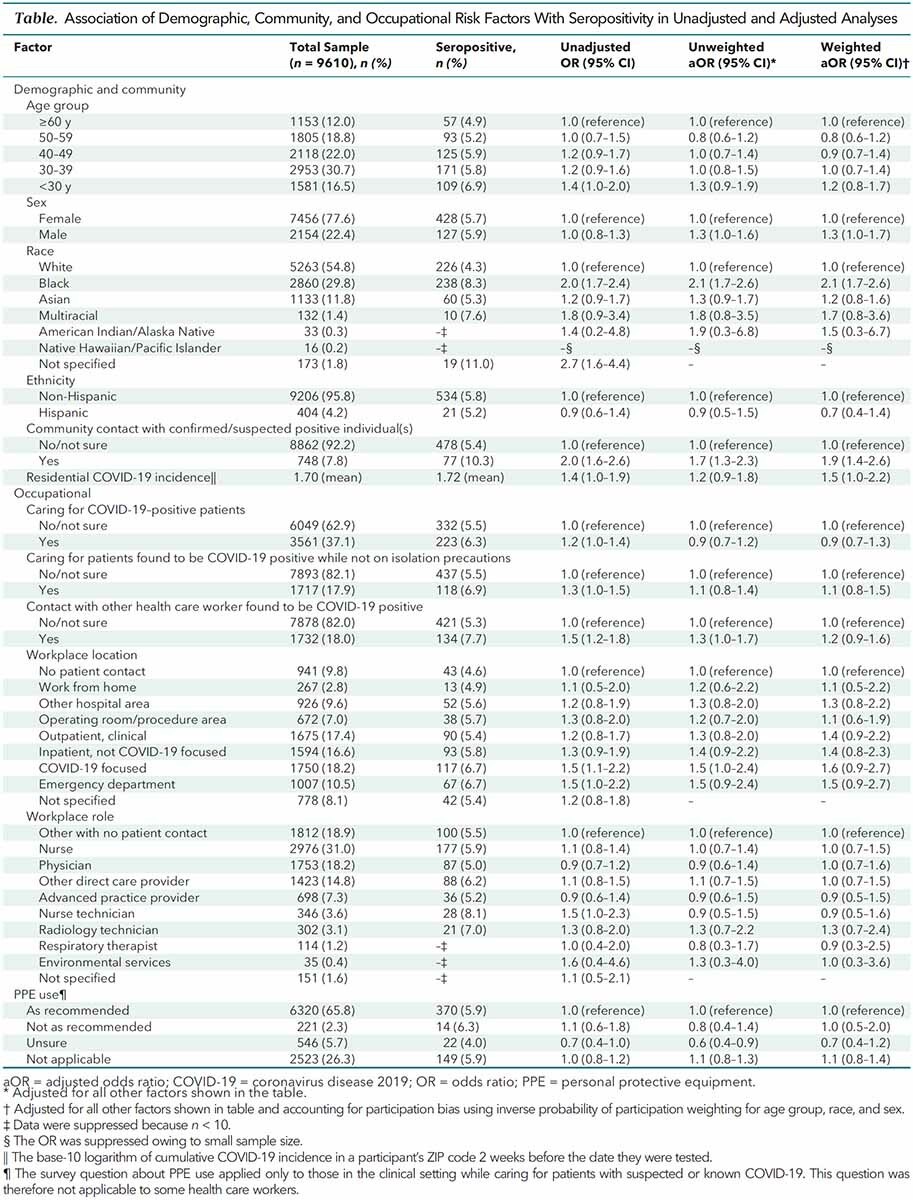
Emory Healthcare: Occupational and Community Risk Factors forSARS-CoV-2 Seropositivity Among Health Care Workers


“Health care workers (HCWs) are presumed to be athigh risk for coronavirus disease 2019 (COVID-19)through occupational exposure to infected patients orcoworkers. Studies have reported a wide range of sero-prevalence of severe acute respiratory syndrome corona-virus 2 (SARS-CoV-2), the virus that causes COVID-19,among HCWs. This variation has in part been attributedto differential risk for exposure in the community. Indeed, recent studies have shown that a substantialnumber of infections among HCWs could not be tracedto occupational exposures and that community expo-sures were as or more strongly associated with infection.”

Continue reading

Executive Leadership During COVID-19

Members of the Advisory Board of the Washington, DC-based Nursing Executive Center offer “5 Executive Actions to Engage Staff Amid COVID-19:

  • Ensure that staff are safe and feel safe when working.
  • Reinvigorate your staff input channels and act on what you can.
  • Do not sugarcoat the challenge ahead.
  • Plan for your worst-case scenarios so you do not go back on even one commitment.
  • Transition your leaders from sprint mode to marathon mode.”

Berkow S, Virkstis K, Herleth A, Whitemarsh K, Rewers L. An Executive Strategy to Support Long-Term Clinician Engagement Amid the COVID-19 Pandemic. J Nurs Adm. 2020 Dec;50(12):616-617. doi: 10.1097/NNA.0000000000000946. PMID: 33181597.
Full text for Emory Users

Continue reading

What strategies can hospital administrations take to alleviate and prevent psychological issues encountered by clinicians on the Covid-19 frontlines?

Clinicians caring for Covid-19 patients have shown multiple signs of stress including anxiety, depression and sleep disturbance.1 Predictors of these adverse effects include young age, low work experience, female gender, heavy workload, working in unsafe settings, and lack of training and social support.2

Issues in COVID-19 care that may provoke these problems include “limited information about COVID-19, unpredictable tasks and challenging practices, insufficient support, concerns about family, and emotional and psychological stress”3, as well as “working in an isolated environment, concerns about personal protective equipment shortage and usage, physical and emotional exhaustion, intensive workload, fear of being infected, and insufficient work experiences with COVID-19.”4

Continue reading

Communication options with patients under isolation precautions: Covid 19

Fang, J., Liu, Y. T., Lee, E. Y., & Yadav, K. (2020). Telehealth Solutions for In-hospital Communication with Patients Under Isolation During COVID-19. The western journal of emergency medicine, 21(4), 801–806. https://doi.org/10.5811/westjem.2020.5.48165

Reengineering the patient’s environment: Establishment of a “Red Box” to improve communications with patients on isolation precautions. (2019). American Journal of Infection Control : Applied Epidemiology in Health Care Settings and the Community, 47(3), 264.

Communication strategies to mitigate fear and suffering among COVID-19 patients isolated in the ICU and their families. (2020). Heart & Lung., 49(4), 344.

Fan, P., Aloweni, F., Lim, S. H., Ang, S. Y., Perera, K., Quek, A. H., Quek, H., & Ayre, T. C. (2020). Needs and concerns of patients in isolation care units – learnings from COVID-19: A reflection. World journal of clinical cases, 8(10), 1763–1766. https://doi.org/10.12998/wjcc.v8.i10.1763

McNairy, M., Bullington, B., & Bloom-Feshbach, K. (2020). Searching for Human Connectedness During COVID-19. Journal of general internal medicine, 1–2. Advance online publication. https://doi.org/10.1007/s11606-020-06082-9

Vilendrer, S., Patel, B., Chadwick, W., Hwa, M., Asch, S., Pageler, N., Ramdeo, R., Saliba-Gustafsson, E. A., Strong, P., & Sharp, C. (2020). Rapid Deployment of Inpatient Telemedicine In Response to COVID-19 Across Three Health Systems. Journal of the American Medical Informatics Association : JAMIA, 27(7), 1102–1109. https://doi.org/10.1093/jamia/ocaa077