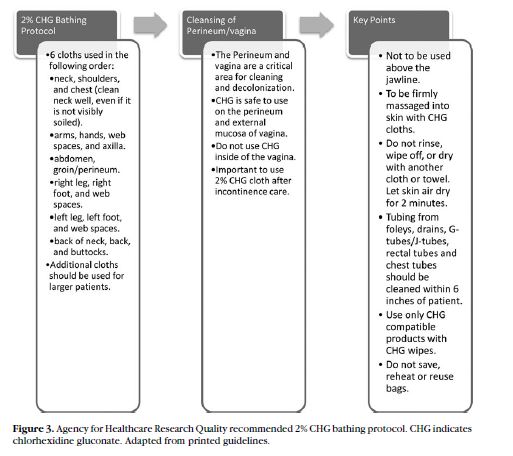
Shah, H. N.,et al. (2016). Bathing With 2% Chlorhexidine Gluconate. Critical Care Nursing Quarterly, 39(1), 42–50
Full Text for Emory Users

Shah, H. N.,et al. (2016). Bathing With 2% Chlorhexidine Gluconate. Critical Care Nursing Quarterly, 39(1), 42–50
Full Text for Emory Users
This systematic review and meta-analysis examines the impact of quality improvement interventions on central line–associated bloodstream infections in adult intensive care units. Studies were identified through Medline and manual searches (1995–June 2012). The results suggest that quality improvement interventions contribute to the prevention of central line–associated bloodstream infections. Implementation of care bundles and checklists appears to yield stronger risk reductions.
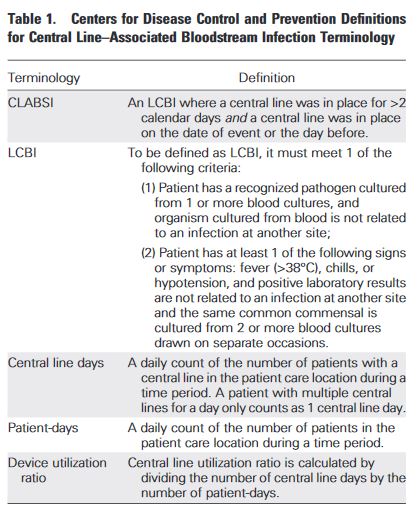
Chlorhexidine Bed-Bath Improves CLABSI: A Meta-Analysis. (2017). Journal of Nursing, 64(4), 71.
A comparative evaluation of antimicrobial coated versus nonantimicrobial coated peripherally inserted central catheters on associated outcomes: A randomized controlled trial. (2016). American Journal of Infection Control : Applied Epidemiology in Health Care Settings and the Community, 44(6), 636.
Frost, S. A., Hou, Y. C., Lombardo, L., Metcalfe, L., Lynch, J. M., Hunt, L., Alexandrou, E., Brennan, K., Sanchez, D., Aneman, A., & Christensen, M. (2018). Evidence for the effectiveness of chlorhexidine bathing and health care-associated infections among adult intensive care patients: a trial sequential meta-analysis. BMC Infectious Diseases, 18(1)
Chlorhexidine bathing and health care-associated infections among adult intensive care patients: A systematic review and meta-analysis. (2016). Critical Care : The Official Journal of the Critical Care Forum., 20, 379.
You get back what you give: Decreased hospital infections with improvement in CHG bathing, a mathematical modeling and cost analysis. (2019). American Journal of Infection Control : Applied Epidemiology in Health Care Settings and the Community, 47(12), 1471.
Chlorhexidine gluconate or polyhexamethylene biguanide disc dressing to reduce the incidence of central-line-associated bloodstream infection: A feasibility randomized controlled trial (the CLABSI trial). (2017). The Journal of Hospital Infection., 96(3), 223.
Central Line-Associated Bloodstream Infections: Chlorhexidine Gluconate Bathing. Moola, Sandeep [BDS MHSM (Hons) MPhil PhD]. [Evidence Summaries] AN: JBI9252
Year of Publication 2018
Bloodstream Infections (Pediatrics): Chlorhexidine Gluconate Bathing. Manuel, Beatriz [MD, MHPE, PhD candidate]. [Evidence Summaries] AN: JBI9364
Year of Publication 2018
Gilbert, R., Mok, Q., Dwan, K., Harron, T., Moitt, M., Millar, P., . . . Gamble. (n.d.). Impregnated central venous catheters for prevention of bloodstream infection in children (the CATCH trial): A randomised controlled trial. The Lancet., 387(10029), 1732-1742.
Catheter impregnation, coating or bonding for reducing central venous catheter-related infections in adults. (n.d.). The Cochrane Database of Systematic Reviews., 3, The Cochrane database of systematic reviews. , 2016, Vol.3.
Hugill, K. (n.d.). Preventing bloodstream infection in IV therapy. Br J Nurs, 26(14), S4-S10.
Nuckols, T., Keeler, E., Morton, S., Anderson, L., Doyle, B., Booth, M., . . . Shekelle, P. (2016). Economic Evaluation of Quality Improvement Interventions for Bloodstream Infections Related to Central Catheters: A Systematic Review. JAMA Internal Medicine, 176(12), 1843-1854.
Jeanes, A., & Bitmead, J. (n.d.). Reducing bloodstream infection with a chlorhexidine gel IV dressing. Br J Nurs, 24(19), S14-S19.
Marang-van de Mheen, P., & Van Bodegom-Vos, L. (n.d.). Meta-analysis of the central line bundle for preventing catheter-related infections: A case study in appraising the evidence in quality improvement. BMJ Quality & Safety., 25(2), 118-129.
Cho, Sun Young, Chung, Doo Ryeon, Ryu, Jae Geum, Choi, Jong Rim, Ahn, Nayeon, Kim, Seonwoo, . . . Song, Jae-Hoon. (n.d.). Impact of Targeted Interventions on Trends in Central Line-Associated Bloodstream Infection: A Single-Center Experience From the Republic of Korea. Critical Care Medicine., 45(6), E552-E558.
Ista, E., Van der Hoven, B., Kornelisse, R., Van der Starre, C., Vos, M., Boersma, E., & Helder, O. (n.d.). Effectiveness of insertion and maintenance bundles to prevent central-line-associated bloodstream infections in critically ill patients of all ages: A systematic review and meta-analysis. The Lancet Infectious Diseases., 16(6), 724-734.
PubMed search: “Catheter-Related Infections/prevention and control”[MAJR] AND education AND (nurse OR nursing)
To examine all 40 results, please use this link: http://tinyurl.com/nd94rxq
choltz, Amy K, et al. “Central venous catheter dress rehearsals: translating simulation training to patient care and outcomes.” Simulation in Healthcare 8.5 (2013):341-9.
Frampton, Geoff K, et al. “Educational interventions for preventing vascular catheter bloodstream infections in critical care: evidence map, systematic review and economic evaluation.” Health technology assessment 18.15 (2014):1-365.
Reed, Seth M, Alexandra JBrock, and Tyler JAnderson. “CE: Champions for central line care.” American journal of nursing 114.9 (2014):40-8; test 49.
Raup, Glenn H, JoycePutnam, and KathyCantu. “Can an education program reduce CLABSIs?” Nursing Management 44.5 (2013):20-2.
Fakih, Mohamad G, et al. “Peripheral venous catheter care in the emergency department: education and feedback lead to marked improvements.” American journal of infection control 41.6 (2013):531-6.
Peredo, R, et al. “Reduction in catheter-related bloodstream infections in critically ill patients through a multiple system intervention.” European journal of clinical microbiology & infectious diseases 29.9 (2010):1173-7.
Semelsberger, Carrie F. “Educational interventions to reduce the rate of central catheter-related bloodstream infections in the NICU: a review of the research literature.” Neonatal network 28.6 (2009):391-5.
Vandijck, Dominique M, et al. “The role of nurses working in emergency and critical care environments in the prevention of intravascular catheter-related bloodstream infections.” International emergency nursing 17.1 (2009):60-8.
Gerolemou, Louis, et al. “Simulation-based training for nurses in sterile techniques during central vein catheterization.” American journal of critical care 23.1 (2014):40-8.
Ishizuka, Mitsuru, et al. “Needleless closed system does not reduce central venous catheter-related bloodstream infection: a retrospective study.” International surgery 98.1 (2013):88-93.
Newman, Nitza, et al. “Central venous catheter-associated bloodstream infections.” Pediatric blood & cancer 59.2 (2012):410-414.
Ellger, B, et al. “Non-return valves do not prevent backflow and bacterial contamination of intravenous infusions.” Journal of hospital infection 78.1 (2011):31-35.
Graves, Nicholas, Adrian GBarnett, and Victor DRosenthal. “Open versus closed IV infusion systems: a state based model to predict risk of catheter associated blood stream infections.” BMJ open 1.2 (2011):e000188-e000188.
Maki, Dennis G, et al. “Impact of switching from an open to a closed infusion system on rates of central line-associated bloodstream infection: a meta-analysis of time-sequence cohort studies in 4 countries.” Infection control and hospital epidemiology 32.1 (2011):50-58.
McAfee, Nancy, et al. “A continuous quality improvement project to decrease hemodialysis catheter infections in pediatric patients: use of a closed luer-lock access cap.” Nephrology Nursing Journal 37.5 (2010):541-4.
Jarvis, William R, et al. “Health care-associated bloodstream infections associated with negative- or positive-pressure or displacement mechanical valve needleless connectors.” Clinical infectious diseases 49.12 (2009):1821-1827.
Ishizuka, Mitsuru, et al. “Valve system does not reduce the catheter-related bloodstream infection.” Journal of investigative surgery 22.6 (2009):430-434.
Vilins, Margarete, et al. “Rate and time to develop first central line-associated bloodstream infections when comparing open and closed infusion containers in a Brazilian Hospital.” The Brazilian journal of infectious diseases 13.5 (2009):335-340.
Ivy, D D, et al. “Closed-hub systems with protected connections and the reduction of risk of catheter-related bloodstream infection in pediatric patients receiving intravenous prostanoid therapy for pulmonary hypertension.” Infection control and hospital epidemiology 30.9 (2009):823-829.
Franzetti, F, et al. “Impact on rates and time to first central vascular-associated bloodstream infection when switching from open to closed intravenous infusion containers in a hospital setting.” Epidemiology and Infection 137.7 (2009):1041-1048.
Blake, Molly. “Update: Catheter-related bloodstream infection rates in relation to clinical practice and needleless device type.” The Canadian journal of infection control 23.3 (2008):156-60, 162.
 Evidence Matters