Operationalizing the CNS role

“Today’s CNS scope of responsibilities encompasses micro, meso, and macro systems levels, and the impact is great. Role responsibilities vary widely, and positioning on the organization chart varies widely as well; CNSs are rising to the occasion. Although a strength of the CNS role can be the variability in the role responsibilities among healthcare settings, it has resulted in challenges in the delivery of education to best prepare for this vital advanced practice role.” (Coke)

Coke, L. A. (2021). Now is the Time for the Clinical Nurse Specialist: Recognizing Value and Advancing the CNS Role. Clinical Nurse Specialist: The Journal for Advanced Nursing Practice, 35(4), 218–219 Full Text for Emory Users

Continue reading

What considerations should be given during the patient handover between ED and intensive care unit (ICU)?

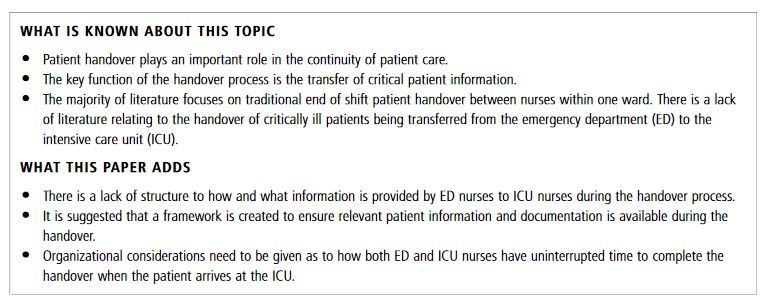
“The transfer of information between nurses from emergency departments (EDs) and critical care units is essential to achieve a continuity of effective, individualized and safe patient care. The aim of this study was to explore the process of patient handover between ED and intensive care unit (ICU) nurses when transferring a patient from ED to the ICU. Qualitative analysis of the data revealed that there was no structured and consistent approach to how handovers actually occurred. Nurses from both ED and ICU lacked clarity as to when the actual handover process began. Nurses from both settings recognized the importance of the information given and received during handover and deemed it to have an important role in influencing quality and continuity of care. Nurses from both departments would benefit from a structured framework or aide memoir to guide the handover process. Collaborative work between the nursing teams in both departments would further enhance understanding of each others’ roles and expectations.”

McFetridge, B., Gillespie, M., Goode, D., & Melby, V. (n.d.). An exploration of the handover process of critically ill patients between nursing staff from the emergency department and the intensive care unit. Nursing in Critical Care.,12(6), 261-269.
Full text for Emory Users

Continue reading

Implementing interdisciplinary huddles for patient care.

Communication Huddles: The Secret of Team Success. (2018). The Journal of Continuing Education in Nursing., 49(10), 451.

Dutka, P. (2016). Patient Safety & Quality Care. The Huddle: It’s Not Just for Football Anymore. Nephrology Nursing Journal, 43(2), 161–162.
Effective multidisciplinary huddle implementation: Key components. (2018). Nursing Management., 49(9), 9.

Branda, M. E., Chandrasekaran, A., Tumerman, M. D., Shah, N. D., Ward, P., Staats, B. R., Lewis, T. M., Olson, D. K., Giblon, R., Lampman, M. A., & Rushlow, D. R. (2018). Optimizing huddle engagement through leadership and problem-solving within primary care: A study protocol for a cluster randomized trial. Trials, 19(1), N.PAG.

McBeth, C. L. (2017). Interprofessional Huddle: One Children’s Hospital’s Approach to Improving Patient Flow. Pediatric Nursing, 43(2), 71–95.

Having more than one person work together to insert an urinary catheter

Relevant systematic reviews and guidelines do not mention having more than one person insert an urinary catheter.

Following are citations and links to full text for three items in which two people worked together to insert catheters:

Galiczewski JM, Shurpin KM. An intervention to improve the catheter associated urinary tract infection rate in a medical intensive care unit: Direct observation of catheter insertion procedure. Intensive Crit Care Nurs. 2017 Jun;40:26-34. doi: 10.1016/j.iccn.2016.12.003. Epub 2017 Feb 22. Excerpt: “CAUTI rates decreased from 2.24 to 0 per 1000 catheter days.” Three comments are available on this article. To view them, go here, and then copy and paste this url into the browser so that the Find it & Emory button will be available: https://www.ncbi.nlm.nih.gov/sites/myncbi/1HMKnKhQm_d5i/collections/58794408/public/.

Fletcher-Gutowski S, Cecil J. Is 2-person urinary catheter insertion effective in reducing CAUTI? Am J Infect Control. 2019 Jul 16. pii: S0196-6553(19)30575-9. doi: 10.1016/j.ajic.2019.05.014. [Epub ahead of print]. Excerpt: “The results of this study indicate implementation of the 2-person urinary catheter insertion protocol with a checklist decreased the risk of CAUTI for our patient population.”

Breiter Y et al. 9-186 – Catheter-associated urinary tract infection reduction in the emergency department as a result of dual personnel urinary catheter insertion. American Journal of Infection Control. 2016;44:6(S88-S89). (this is only an abstract; 201 patients underwent dual personnel urinary catheter insertion; none developed a CAUTI)

Heudorf U. Grünewald M, Otto U. Implementation of the updated 2015 Commission for Hospital Hygiene and Infection Prevention (KRINKO) recommendations “Prevention and control of catheter-associated urinary tract infections” in the hospitals in Frankfurt/Main, Germany. GMS Hyg Infect Control. 2016 Jun 30;11:Doc14. doi: 10.3205/dgkh000274. eCollection 2016. Excerpt: “demonstrations were always performed by two persons (the second to hand the sterile materials to the first).”

Updated 8/23/2019 ldt

What is the evidence on strategies for coping with moral distress for nurses working with heart failure patients?

There are several relevant papers on coping strategies, but not specific to heart failure.

Search strategy (database and search terms):

Joanna Briggs
Search terms: moral distress

Identified a systematic review that includes some discussion of coping.
How professional nurses working in hospital environments experience moral distress: a systematic review.
Rittenmeyer L, Huffman, D.  How professional nurses working in hospital environments experience moral distress: a systematic review.  The JBI Library of Systematic Reviews. 7(28):1234-1291, 2009.

PubMed

This search identifies over a hundred articles.  You may be especially interested in these references that are available through this search:

Moral distress: levels, coping and preferred interventions in critical care and transitional care nurses.  Wilson MA, Goettemoeller DM, Bevan NA, McCord JM. J Clin Nurs. 2013 May;22(9-10):1455-66. doi: 10.1111/jocn.12128. Epub 2013 Mar 8.
PMID: 23473022

How professional nurses working in hospital environments experience moral distress: a systematic review.  Huffman DM, Rittenmeyer L. Crit Care Nurs Clin North Am. 2012 Mar;24(1):91-100. doi: 10.1016/j.ccell.2012.01.004. Epub 2012 Feb 3. Review.
PMID: 22405714

Innovative solutions: the effect of a workshop on reducing the experience of moral distress in an intensive care unit setting.  Beumer CM. Dimens Crit Care Nurs. 2008 Nov-Dec;27(6):263-7. doi: 10.1097/01.DCC.0000338871.77658.03.
PMID: 18953194

Defining and addressing moral distress: tools for critical care nursing leaders.  Rushton CH. AACN Adv Crit Care. 2006 Apr-Jun;17(2):161-8.
PMID: 16767017

Identified one article on managing heart failure that discusses moral distress.
Nurs Res. 2014 Sep-Oct;63(5):357-65. doi: 10.1097/NNR.0000000000000049.
Managing heart failure in the long-term care setting: nurses’ experiences in Ontario, Canada.  Strachan PH.

Emotional intelligence and nursing

Ranjbar, Hossein. “Emotional intelligence training: A necessity for nursing education curriculum.” Nurse Education Today 35.11 (2015):1053.

Teaching safety in nursing practice: Is emotional intelligence a vital component?.” Teaching and learning in nursing 10.2 (2015):88.

Emotional intelligence – essential for trauma nursing.” International emergency nursing 23.1 (2015):13.

A study of the influence of nursing education on development of emotional intelligence.” Journal of professional nursing 30.6 (2014):511.

Emotional Intelligence (EI) and Nursing Leadership Styles Among Nurse Managers.” Nursing administration quarterly 39.2 (2015):172.