Drills for low frequency, high acuity events

“Patient outcomes during crisis events directly link to healthcare providers’ swift and appropriate actions, with nurses often the first responders to crisis events within the hospital. Crisis events, such as rapid responses and cardiac arrests, can prompt staff fear and anxiety regardless of years of professional experience, leading to hesitation and low self-confidence in decision-making. To optimize patient outcomes in crisis events, nursing staff should identify a decompensating patient quickly and begin competently performing resuscitation tasks. Previous mock code studies have found alarming delays in resuscitation tasks and overall poor performance; recommendations often discuss the need to focus on the first responders and the tasks being completed before the code team’s arrival Thus, the most critical period of the resuscitation process is left in the hands of nursing staff as first responders.

Bennett, J., et al (2021). Optimizing Nursing Response to Crisis Events through In-Situ Simulation. Medsurg Nursing, 30(2), 108-114.

Continue reading

Emory Authors: Fluid Resuscitation in the Treatment of Acute Pancreatitis: Rate and Volume Controversies

“The aim of the Research to Practice column is to enhance the research critique abilities of both advanced practice registered nurses and emergency nurses, while also aiding in the translation of research findings into clinical practice. Each column focuses on a specific topic and research study. In this article, we used a scenario of left upper quadrant pain to explore the study by de-Madaria et al., titled “Aggressive or moderate fluid resuscitation in acute pancreatitis”.

Continue reading

Emory Authors: Evaluating Stigma Toward Individuals With Substance Use Disorder Among Prelicensure Nursing Students

“Stigma is acutely problematic in health care. The effects of institutional and health care provider stigma toward People with Substance Use Disorder (PWSUD) are sizeable, resulting in undertreatment, resistance to seeking and undergoing treatment, diminished therapeutic alliance, and lower-quality care. In a recent scoping review, Cazalis et al
note that approximately 20% to 51% of health care providers potentially hold negative beliefs/feelings toward PWSUD. As a result, PWSUD underutilize health care services to avoid distressing and stigmatizing experiences within the health care system, such as
decreased health care provider regard and empathy and increased discrimination. Substantial effort is needed to mitigate stigma among health care providers to provide improved quality of care and life for those with SUD.”

Continue reading

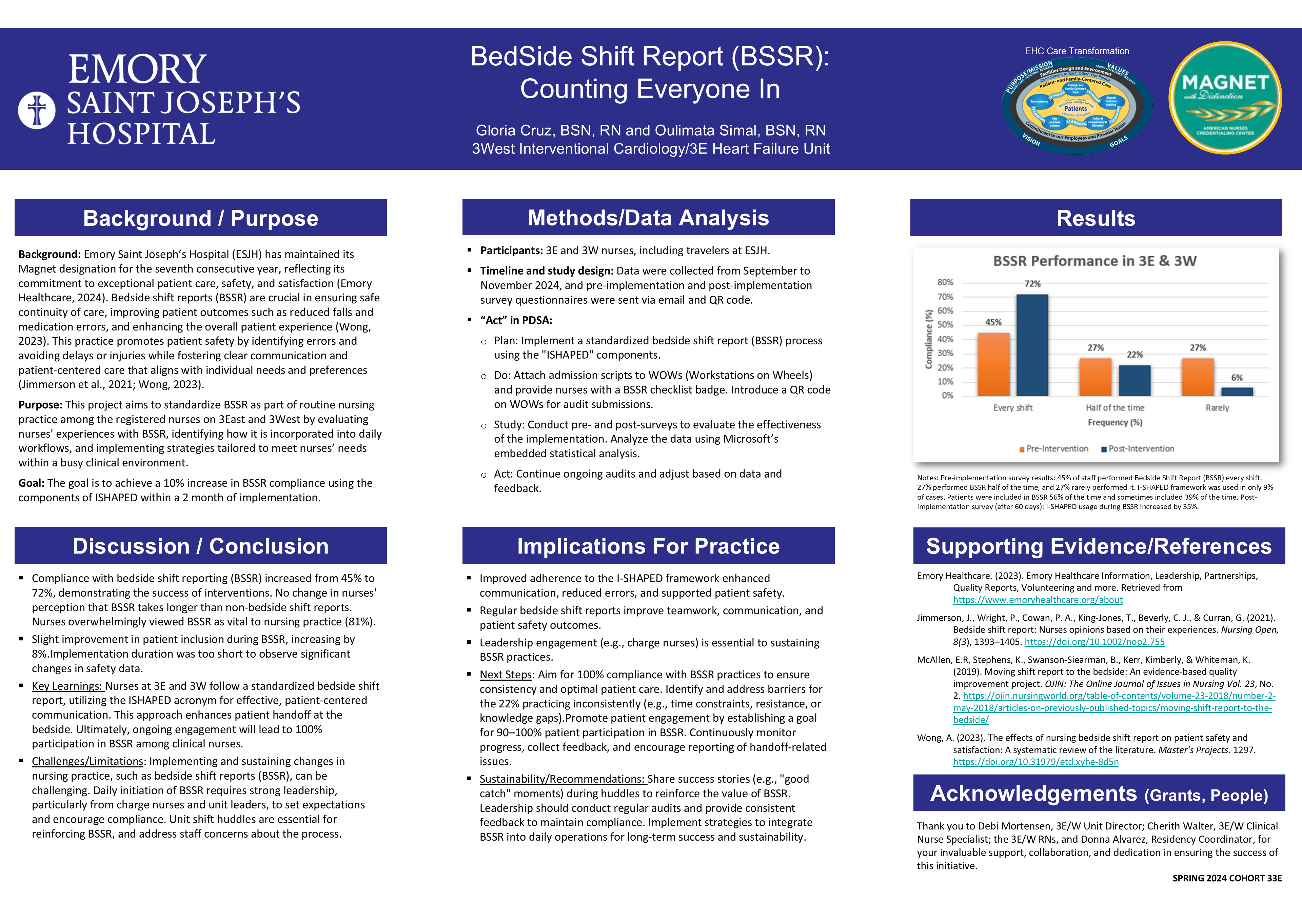
BedSide Shift Report (BSSR): Counting Everyone In

: Emory Saint Joseph’s Hospital (ESJH) has maintained its Magnet designation for the seventh consecutive year, reflecting its commitment to exceptional patient care, safety, and satisfaction (Emory Healthcare, 2024). Bedside shift reports (BSSR) are crucial in ensuring safe continuity of care, improving patient outcomes such as reduced falls and medication errors, and enhancing the overall patient experience (Wong, 2023). This practice promotes patient safety by identifying errors and avoiding delays or injuries while fostering clear communication and patient-centered care that aligns with individual needs and preferences (Jimmerson et al., 2021; Wong, 2023).

Gloria Cruz, BSN, RN and Oulimata Simal, BSN, RN 3West Interventional Cardiology/3E Heart Failure Unit BedSide Shift Report (BSSR): Counting Everyone In [Emory Healthcare Nurse Residency] Emory Saint Joseph’s Hospital, Atlanta GA

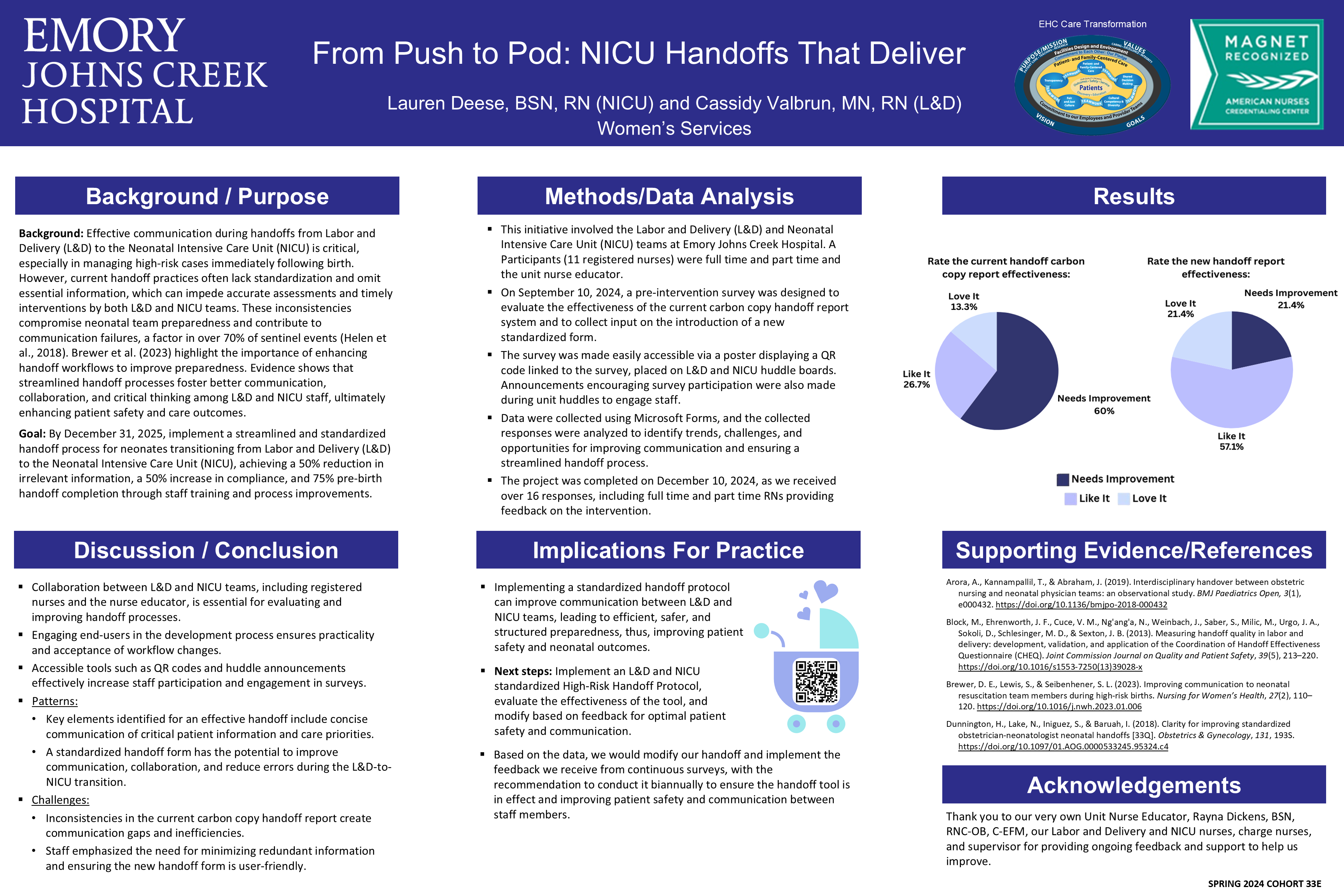
From Push to Pod: NICU Handoffs That Deliver

“Effective communication during handoffs from Labor and Delivery (L&D) to the Neonatal Intensive Care Unit (NICU) is critical, especially in managing high-risk cases immediately following birth. However, current handoff practices often lack standardization and omit essential information, which can impede accurate assessments and timely interventions by both L&D and NICU teams. These inconsistencies compromise neonatal team preparedness and contribute to communication failures, a factor in over 70% of sentinel events (Helen et al., 2018). Brewer et al. (2023) highlight the importance of enhancing handoff workflows to improve preparedness. Evidence shows that streamlined handoff processes foster better communication, collaboration, and critical thinking among L&D and NICU staff, ultimately enhancing patient safety and care outcomes.”

Lauren Deese, BSN, RN (NICU) and Cassidy Valbrun, MN, RN (L&D) Women’s Services From Push to Pod: NICU Handoffs That Deliver [Emory Healthcare Nurse Residency] Emory Saint Joseph’s Hospital, Atlanta GA

Breathing Better: Enhancing IS Compliance through Nursing Interventions

“Patients undergoing surgery, particularly those with pre-existing respiratory conditions or chest tubes, face a high risk of postoperative pulmonary complications, such as hypoxia and pneumothorax, which can prolong hospital stays and worsen outcomes (Dhillon et al., 2023). The incentive spirometer (IS), a non-invasive tool designed to encourage deep breathing and lung expansion, effectively prevents such complications. However, adherence to IS use is often hindered by insufficient patient education and inconsistent reminders. Studies suggest that interactive tools like checklists and reminder systems can significantly improve IS engagement and documentation (Kneuertz et al., 2020; Pangborn et al., 2020).”

Winifred Afu, BSN, RN; Anna Gabriel, BSN, RN; Somi Kim, MN, RN and Sarah Muh, BSN, RN (2 South CV Stepdown); Jennifer Nguyen MN, RN and Teaira Yates, BSN, RN (5 East/West Internal Medicine Breathing Better: Enhancing IS Compliance through Nursing Interventions [Emory Healthcare Nurse Residency] Emory Saint Joseph’s Hospital, Atlanta GA