What factors increase successful dental care of ventilated patients?

Dental plaque colonization may be exacerbated in the absence of adequate oral hygiene care in critically ill, mechanically ventilated patients. Dental care is made more difficult due to the presence of the endotracheal tube, which may create:

  • mechanical injury of the mouth or respiratory tract
  • increased likelihood of dry mouth[1]

Using visual research and interviews, oral access and delivery of care for mechanically ventilated patients was analyzed, resulting in the following recommendations.
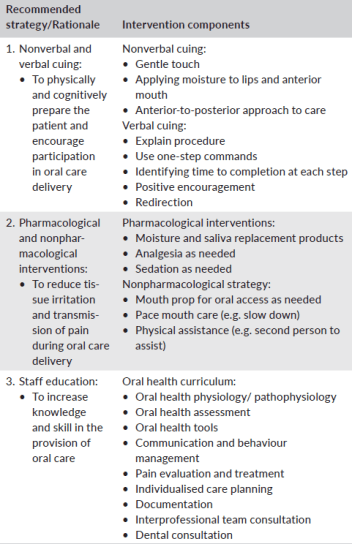
Recommendations to improve oral access and care delivery.

Dale CM, Angus JE, Sutherland S, Dev S, Rose L. Exploration of difficulty accessing the mouths of intubated and mechanically ventilated adults for oral care: A video and photographic elicitation study. J Clin Nurs. 2020 Jun;29(11-12):1920-1932. doi: 10.1111/jocn.15014. Epub 2019 Aug 20. PMID: 31342565.
Full Text for Emory Users

Continue reading

use of technology in achieving compliance with ventilator care bundles

Thomas R. Talbott, Devin Carr, C. Lee Parmley, Barbara J. Martin, Barbara Gray, Anna Ambrose, Jack Starmer. Sustained reduction of ventilator-associated pneumonia rates using real-time course correction with a ventilator bundle compliance dashboard. Infection Control and Hospital Epidemiology, 2015, Vol. 36(11), pp. 1261-1267.

Haitao Lan, Charat Thongprayoon, Adil Ahmed, Vitaly Herasevich, Priya Sampathkumar, Ognjen Gajic, John C. O’Horo. Automating quality metrics in the era of electronic medical records: digital signatures for ventilator bundle compliance. BioMed Research International, 2015, Vol. 2015, pp. 396508-396508.

Victor Zaydfudim, Lesly A. Dossett, John M. Starmer, Patrick G. Arbogast, Irene D. Feurer, Wayne A. Ray, Addison K. May, C. Wright Pinson. Implementation of a real-time compliance dashboard to help reduce SICU ventilator-associated pneumonia with the ventilator bundle. Archives of Surgery, 2009, Vol. 144(7), pp. 656-662.

P. Mathur, V. Tak, J. Gunjiyal, S. A. Nair, S. Lalwani, S. Kumar, B. Gupta, S. Sinha, A. Gupta, D. Gupta, M. c. Misra. Device-associated infections at a level-1 trauma centre of a developing nation: impact of automated surveillance, training and feedbacks. Indian Journal of Medical Microbiology, 2015, Vol. 33(1), pp.51-62.

Search string used in PubMed by HR: (ventilator-associated OR ventilator AND bundle) AND (compliance OR compliant) AND (digital OR computer OR computerized OR technology OR automated OR automatic)

What is the evidence for oral care of a patient on a ventilator?

The systematic reviews identified below include slightly different findings, so a review of the objective of each review, as well as the patient populations in the included studies, will be important for extrapolating results to a specific setting.  Guidelines were identified in DynaMed and in PubMed.

Evidence summary resources

From Mechanical Ventilation entry.  In:  DynaMed Plus.
Under Adjunctive Therapies > Other Supportive Care

  • A systematic review (JAMA 2014) found that oral care with chlorhexidine may reduce lower respiratory tract infections in adults following cardiac surgery, but is not associated with reduction in VAP in non-cardiac surgery patients.  The review was limited by the heterogeneity of the settings/populations.

JAMA Intern Med. 2014 May;174(5):751-61. Klompas M, et al. Reappraisal of routine oral care with chlorhexidine gluconate for patients receiving mechanical ventilation: systematic review and meta-analysis.

  • A systematic review (with heterogeneity) of 6 RCTs concluded that toothbrushing may not reduce risk of ventilator-associated pneumonia in critically ill patients
  • Society for Healthcare Epidemiology of America (SHEA) guideline on strategies to prevent ventilator-associated pneumonia in acute care hospitals Infect Control Hosp Epidemiol 2008 Oct;29 Suppl 1:S31

From Joanna Briggs

Oral Hygiene Care: Acute Care Setting.  Chu WH.  [Evidence Summaries], AN: JBI5215, 2013.
References a systematic review (Cochrane 2013) concluded that use of chlorhexidine was associated with reduction in rate of VAP in adult, but not pediatric, patients.

Cochrane Database Syst Rev. 2013 Aug 13;8:CD008367.   Shi Z, et al. Oral hygiene care for critically ill patients to prevent ventilator-associated pneumonia.

Oral Care.  [Recommended Practices, AN: JBI5264, 2013.
References a systematic review (Am J Crit Care 2007) concluding that toothbrushes can be a source of contamination and should be kept clean.

PubMed

View the results of a search for relevant systematic reviews and meta-analyses:
(“Pneumonia, Ventilator-Associated/prevention and control”[Mesh] OR “Respiration, Artificial/adverse effects”[Mesh]) AND (“Anti-Infective Agents, Local”[nm] OR “oral hygiene”[MeSH Terms]) AND (Meta-Analysis[ptyp] OR systematic[sb])

Additional guideline

Berry AM, et al. Consensus based clinical guideline for oral hygiene in the critically ill. Intensive Crit Care Nurs. 2011 Aug;27(4):180-5.

What is the recent evidence for intentional rounds in the intensive care unit?

Searched CINAHL and PubMed for patient rounds AND (“intensive care” OR “critical care”)  with a limit of English.

Six quasi-experimental studies in CINAHL measuring nurse satisfaction, ventilator-associated pneumonia, cental-line associated bloodstream infection, nosocomial infections, healthcare outcomes, family presence, and facilitators and barriers to patient care rounds
Adding intensive care or critical care eliminates many studies that may also be relevant.

(MH “Patient Rounds”) AND (hourly OR intentional OR proactive OR comfort)
These results include several experimental and quasi-experimental studies. If you want to look at specific outcomes, see the following searches for particular topics:

Falls – (MH “Patient Rounds”) AND (hourly OR intentional OR proactive OR comfort) AND falls

Patient satisfaction – (MH “Patient Rounds”) AND (hourly OR intentional OR proactive OR comfort) AND patient satisfaction

Patient centered care – (MH “Patient Rounds”) AND (MH “Patient centered care”)

Papers in PubMed search: (rounds OR rounding) AND (intentional OR hourly OR time factors OR proactive) AND (nurses OR nursing) AND (safety OR quality improvement OR infection OR pneumonia OR pressure ulcers OR falls OR patient satisfaction OR patient outcome assessment OR outcomes assessments) AND (“intensive care” OR “critical care”)
This search retrieves papers examining common outcomes in the intensive care unit.  Other outcomes can be included in the search.

Reviewed and updated 5/1/2014 ldt

Does frequency of providing stoma and inner canula care reduce rate of VAP in patients with tracheostomy?

Bottom line:  There is not much evidence available on this question.  Most recommendations are based on expert opinion.

A search of PubMed and CINAHL for these concepts–tracheotomy, tracheostomy, ventilator-associated pneumonia, prevention–revealed one study specifically examining care of the tracheostomy–Eid RC, et al.  Successful prevention of tracheostomy associated pneumonia in step-down units.  Am J Infect Control. 2011 Aug;39(6):500-5.
Intervention included “drainage and discarding of condensate” in the tubing at least 3 times per day, but this doesn’t say specifically changing the tubing. No additional studies identified that evaluated care of the tracheostomy in preventing outcome of ventilator-associated pneumonia.

Tracheostomy: Stoma Care.  Joanna Briggs Institute, 2010.  States that evidence regarding tracheostomy is mostly based on expert opinion as there are not many published studies on tracheostomy procedures and care.

Tracheostomy:  Management – references guideline that relies on expert opinion in recommendation

Cites this small study that found no statistically significant difference in bacterial colonization between patients who had canula changed daily versus those who did not.

Burns SM, et al.  Are frequent inner cannula changes necessary?: A pilot study.  Heart Lung. 1998 Jan-Feb;27(1):58-62.
This small study that found no statistically significant difference in bacterial colonization between patients who had canula changed daily versus those who did not.  Did not look at ventilator-associated pneumonia rates.

What is the standard for changing the inner cannula and performing stoma care in tracheostomies?

Bottom line:  Recommendations for tracheostomy management include daily cleaning of inner canula, as well as routine cleaning and daily inspections of the stoma.

Summary
Tracheostomy: Stoma Care.  Joanna Briggs Institute.  April 26, 2010.
Recommends routine cleaning and daily inspection for signs of infection in the skin around the stoma.  Evidence based on expert opinion.

AACN Procedure Manual, 6th ed, 2011 .
Recommends monitoring skin around stoma for breakdown.

Tracheostomy:  Management.  Joanna Briggs Institute, October 29, 2010.  
Recommends cleaning inner cannula daily based on guidelines that did not cite studies, but relied on expert opinion.

AHRQ-sponsored intervention reduces rates of ventilator-associated pneumonia (VAP) in intensive care units (ICUs)

Matar, Dany S, et al. “Achieving and sustaining ventilator-associated pneumonia-free time among intensive care units (ICUs): evidence from the Keystone ICU Quality Improvement Collaborative.” Infection control and hospital epidemiology 34.7 (2013):740-743.
This retrospective analysis of the Michigan Keystone intensive care unit (ICU) collaborative showed that a zero rate of VAP could be attained and sustained for a considerable period of time in adult ICUs.

Berenholtz SM, et al. “Collaborative cohort study of an intervention to reduce ventilator-associated pneumonia in the intensive care unit. Infection control and hospital epidemiology 32.4 (2011):305-314.
Study of an intervention consisting of the Comprehensive Unit-Based Safety Program (CUSP) and a ventilator care bundle of five evidence-based practices from the Centers for Disease Control and Prevention. Reduced rates of VAP by up to 71% at 112 Michigan intensive care units (ICUs).

Reviewed and updated 4/24/2014 ldt