What is the best treatment for hypertensive disorders of pregnancy?

“All oral anti-hypertensives reduced blood pressure to the reference range in most women. As single drugs, nifedipine retard use resulted in a greater frequency of primary outcome attainment than labetalol or methyldopa use. All three oral drugs—methyldopa, nifedipine, and labetalol—are viable initial options for treating severe hypertension in low-resource settings.” 1

“Labetalol intravenously and methyldopa orally are then the two most frequently used drugs. Short-acting oral nifedipine is suggested to be used only if other drugs or iv access are not available.” 2

(1) Easterling T, Mundle S, Bracken H, Parvekar S, Mool S, Magee LA, von Dadelszen P, Shochet T, Winikoff B. Oral antihypertensive regimens (nifedipine retard, labetalol, and methyldopa) for management of severe hypertension in pregnancy: an open-label, randomised controlled trial. Lancet. 2019 Sep 21;394(10203):1011-1021. doi: 10.1016/S0140-6736(19)31282-6. Epub 2019 Aug 1. PMID: 31378394; PMCID: PMC6857437.
Free Full Text

(2) Cífková R, Johnson MR, Kahan T, Brguljan J, Williams B, Coca A, Manolis A, Thomopoulos C, Borghi C, Tsioufis C, Parati G, Sudano I, McManus RJ, van den Born BH, Regitz-Zagrosek V, de Simone G. Peripartum management of hypertension: a position paper of the ESC Council on Hypertension and the European Society of Hypertension. Eur Heart J Cardiovasc Pharmacother. 2020 Nov 1;6(6):384-393. doi: 10.1093/ehjcvp/pvz082. PMID: 31841131.
Free Full Text

Further Reading

Deshmukh US, Lundsberg LS, Culhane JF, Partridge C, Reddy UM, Merriam AA, Son M. Factors associated with appropriate treatment of acute-onset severe obstetrical hypertension. Am J Obstet Gynecol. 2021 May 20:S0002-9378(21)00559-7. doi: 10.1016/j.ajog.2021.05.012. Epub ahead of print. PMID: 34023314.
Full Text for Emory Users

Wilkerson RG, Ogunbodede AC. Hypertensive Disorders of Pregnancy. Emerg Med Clin North Am. 2019 May;37(2):301-316. doi: 10.1016/j.emc.2019.01.008. PMID: 30940374.
Full Text for Emory Users

Cox AG, Marshall SA, Palmer KR, Wallace EM. Current and emerging pharmacotherapy for emergency management of preeclampsia. Expert Opin Pharmacother. 2019 Apr;20(6):701-712. doi: 10.1080/14656566.2019.1570134. Epub 2019 Feb 1. PMID: 30707633.
Full Text for Emory Users

Watson K, Broscious R, Devabhakthuni S, Noel ZR. Focused Update on Pharmacologic Management of Hypertensive Emergencies. Curr Hypertens Rep. 2018 Jun 8;20(7):56. doi: 10.1007/s11906-018-0854-2. PMID: 29884955.
Full Text for Emory Users

Anderson CM, Schmella MJ. CE: Preeclampsia: Current Approaches to Nursing Management. Am J Nurs. 2017 Nov;117(11):30-38. doi: 10.1097/01.NAJ.0000526722.26893.b5. PMID: 29035901.
Full Text for Emory Users
Do oncology nurse-navigators (ONN) improve patient outcomes?

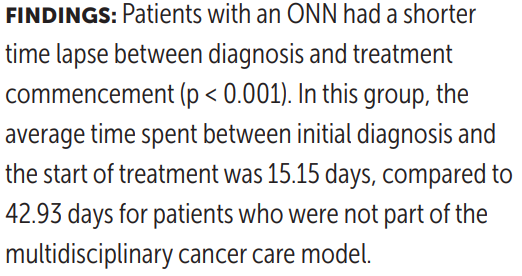
Muñoz R, et al.. Multidisciplinary Cancer Care Model: A Positive Association Between Oncology Nurse Navigation and Improved Outcomes for Patients With Cancer. Clin J Oncol Nurs. 2018 Oct 1;22(5):E141-E145.

Muñoz R, Farshidpour L, Chaudhary UB, Fathi AH. Multidisciplinary Cancer Care Model: A Positive Association Between Oncology Nurse Navigation and Improved Outcomes for Patients With Cancer. Clin J Oncol Nurs. 2018 Oct 1;22(5):E141-E145. doi: 10.1188/18.CJON.E141-E145. PMID: 30239520.
Fulltext for Emory Users

Continue reading

What factors lead to resilient healthcare teams?

Psychological resilience, “the human ability to adapt in the face of tragedy, trauma, adversity, hardship, and ongoing significant life stressors,”[1] is thought to be a state of internal balance where “we are at our best, able to learn, solve problems, and work effectively with others”, resulting in better patient outcomes, and less employee burnout and turnover.[2]

Leadership techniques for team resilience training have been researched. One study found that managers addressed difficult situations by “facilitating teamwork through goalsetting, problem-solving and circumventing the technical systems’ limitations”, noting that increased team collaboration is supported by “team members’ abilities to predict the behavior of each other.”[3] Other strategies include “those that: a) foster connections within the team; b) provide education and training to develop behaviors that assist in controlling or limiting the intensity of stress, or aiding recovery; and c) assist in processing emotion and learning from experiences.”[4]

Additionally, in workshops, medical residents found greater personal strength from the group experience when they reflected on difficult cases and discussed them as a group, along with reviewing the “4 S’s” of resilience (Supports, Strategies, Sagacity [what wisdom did they gain], and Solutions to the problem).[5]

Resiliency is a factor for team success outside of healthcare as well. A Harvard Business Review survey[6] of 2,000 National Collegiate Athletic Association (NCAA) basketball coaches found that,

The “characteristics of a resilient team are:

  • They believe they can effectively complete tasks together.
  • They share a common mental model of teamwork.
  • They are able to improvise.
  • They trust one another and feel safe.”
Continue reading

Executive Leadership During COVID-19

Members of the Advisory Board of the Washington, DC-based Nursing Executive Center offer “5 Executive Actions to Engage Staff Amid COVID-19:

  • Ensure that staff are safe and feel safe when working.
  • Reinvigorate your staff input channels and act on what you can.
  • Do not sugarcoat the challenge ahead.
  • Plan for your worst-case scenarios so you do not go back on even one commitment.
  • Transition your leaders from sprint mode to marathon mode.”

Berkow S, Virkstis K, Herleth A, Whitemarsh K, Rewers L. An Executive Strategy to Support Long-Term Clinician Engagement Amid the COVID-19 Pandemic. J Nurs Adm. 2020 Dec;50(12):616-617. doi: 10.1097/NNA.0000000000000946. PMID: 33181597.
Full text for Emory Users

Continue reading

What factors increase successful dental care of ventilated patients?

Dental plaque colonization may be exacerbated in the absence of adequate oral hygiene care in critically ill, mechanically ventilated patients. Dental care is made more difficult due to the presence of the endotracheal tube, which may create:

  • mechanical injury of the mouth or respiratory tract
  • increased likelihood of dry mouth[1]

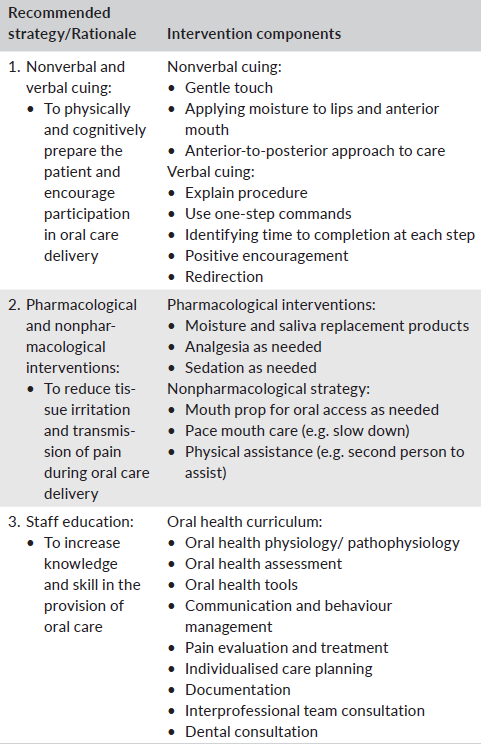
Using visual research and interviews, oral access and delivery of care for mechanically ventilated patients was analyzed, resulting in the following recommendations.

Recommendations to improve oral access and care delivery.

Dale CM, Angus JE, Sutherland S, Dev S, Rose L. Exploration of difficulty accessing the mouths of intubated and mechanically ventilated adults for oral care: A video and photographic elicitation study. J Clin Nurs. 2020 Jun;29(11-12):1920-1932. doi: 10.1111/jocn.15014. Epub 2019 Aug 20. PMID: 31342565.
Full Text for Emory Users

Continue reading

What methods can minimize distractions during medication preparation in the acute care hospital setting?

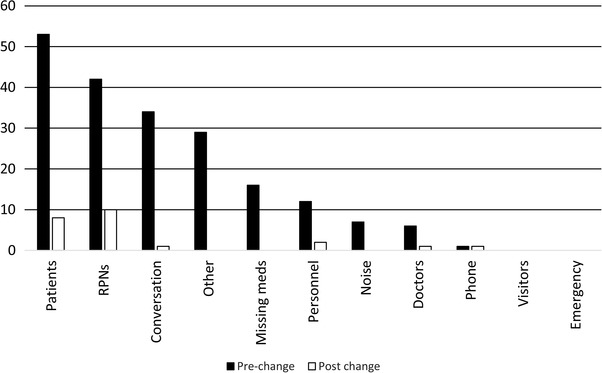
A QI initiative aimed at reducing the number of interruptions and distractions experienced by nurses during the medication administration process examined the effects of:

  • introduction of a medication administration room
  • standardization of the medication administration process

These changes in practice had significant impact, resulting in “an 88.5% reduction in distractions and interruptions.[1]”

Number of distractions or interruptions per source pre- and postimplementation of practice change.

Kavanagh A, Donnelly J. A Lean Approach to Improve Medication Administration Safety by Reducing Distractions and Interruptions. J Nurs Care Qual. 2020 Oct/Dec;35(4):E58-E62. doi: 10.1097/NCQ.0000000000000473. PMID: 32079961.
Full text access for Emory Users.

Continue reading