
“Nurse turnover disrupts continuity of care and imposes substantial recruitment, onboarding, and training costs on healthcare organizations. Rural and underserved organizations face
particular retention challenges because staffing losses may be difficult to replace and can affect access to care. Burnout and secondary traumatic stress (STS) are consistently associated with poorer nurse well-being and turnover-related outcomes, whereas
supportive work environments and organizational attachment can promote retention.”
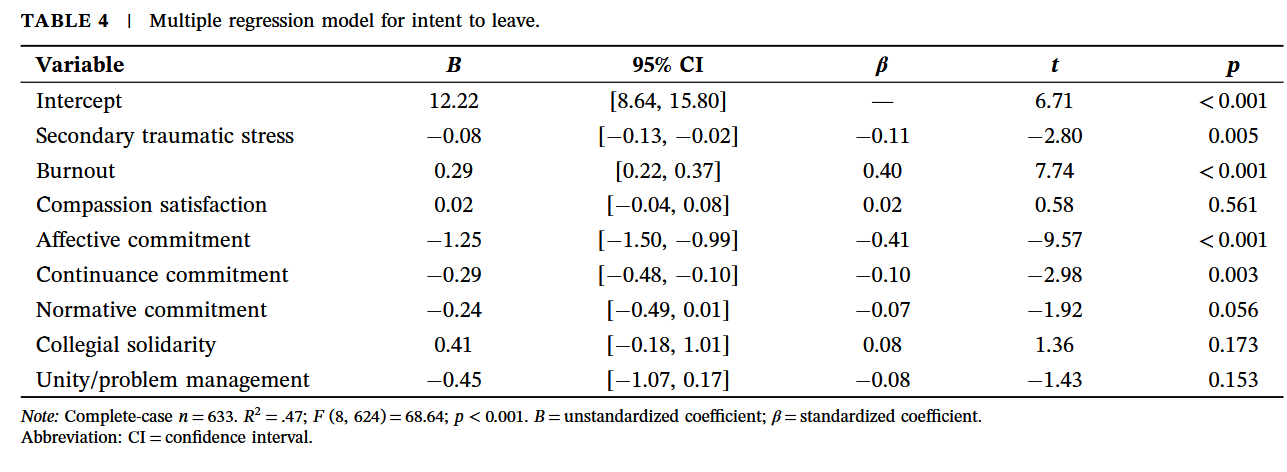
“Burnout, affective commitment, continuance commitment, and STS were independently associated with intent to leave in the multivariable model in this cross-sectional North Dakota sample. Burnout had the largest positive adjusted association, whereas
affective commitment had the largest negative standardized efficient. Nested regression showed that the STS coefficient changed from positive to negative when burnout entered the model, supporting a coefficient-reversal/suppression interpretation arising from shared variance; the negative adjusted coefficient should not be interpreted as a protective effect.
Normative commitment, compassion satisfaction, and team cohesion did not explain significant unique variance after adjustment. These findings identify occupational strain and organizational attachment as candidates for integrated retention-strategy testing. Longitudinal and intervention-based research should determine whether leadership and workforce strategies targeting these domains produce sustained reductions in intent
to leave or actual turnover.”
Kelly, D. R., Leighton, K., Owens, R. A., Zwilling, J., & Schmitz, D. (2026). Professional quality of life, team cohesion, organizational commitment, and intent to leave among nursing personnel: A cross‐sectional study. Journal of Nursing Management, 2026, 1–8.

