
“Health care workers are exposed to an excessive number of alarms that overload their senses, which leads to alarm desensitization. It is estimated that between 80% and 99% of alarms in the clinical areas are false As health care workers become increasingly desensitized to alarms, alarm response rates decrease or diminish all together. Poor alarm response rates result in important alarms being overlooked or ignored because the important alarms are
drowned out by superfluous alarms.” (Srinivasa)
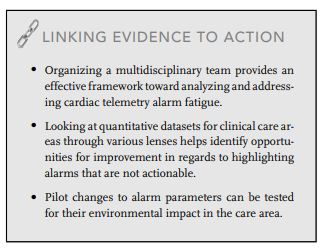
Srinivasa, E., et al (2017). An Evidence-Based Approach to Reducing Cardiac Telemetry Alarm Fatigue. Worldviews on evidence-based nursing, 14(4), 265–273.
Full Text for Emory Users
Chen, D. W., et al (2018). Utilization of continuous cardiac monitoring on hospitalist-led teaching teams. Cureus, 10(9). Free Full Text
Short, K. (2018). Solving alarm fatigue with smartphone technology. Nursing2020 Critical Care, 13(3), 43-47.Full Text for Emory Users
Flanders, K., & Hudson, Z. (2020). Appropriate use of telemetry in the acute care setting. Nursing Management, 51(5), 44-51 Full Text for Emory Users
 Evidence Matters