
“Restraints are likely to negatively affect patients’ health and therefore a reduction in their usage is recommended for all health-care settings. To date, research on restrictive practices has concentrated on mental health and long-term care settings. To ensure restraints are used as little as possible in the acute-care hospital setting, it seems important to investigate more comprehensively the use of restraints, to include all types of restraints irrespective of ward type or subpopulations and to identify factors associated with restraint use. Restraints are often utilised in hospitals in complex care situations such as with patients at risk of falling or with delirium. When using restraints the consideration of processes like documentation and evaluation shows great potential for improvement. Standardisation of these processes and education of the interprofessional team could be beneficial for raising awareness and for the sustainable reduction of restraint use.”
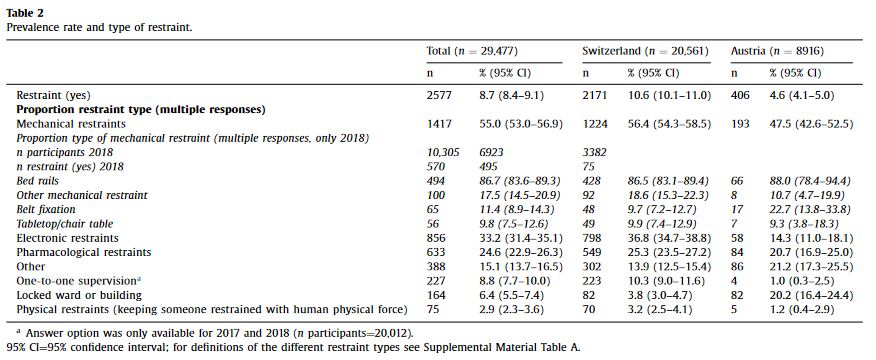
Thomann, S., Zwakhalen, Richter, Bauer, & Hahn. (2021). Restraint use in the acute-care hospital setting: A cross-sectional multi-centre study. International Journal of Nursing Studies,114, 103807.
Francis-Coad, J., Hill, A. M., Jacques, A., Chandler, A. M., Richey, P. A., Mion, L. C., & Shorr, R. I. (2020). Association Between Characteristics of Injurious Falls and Fall Preventive Interventions in Acute Medical and Surgical Units. The journals of gerontology. Series A, Biological sciences and medical sciences, 75(10), e152–e158.
LeLaurin, J. H., & Shorr, R. I. (2019). Preventing Falls in Hospitalized Patients: State of the Science. Clinics in geriatric medicine, 35(2), 273–283.
Booth, Vicky, Logan, Pip, Harwood, Rowan, & Hood, Victoria. (2015). Falls prevention interventions in older adults with cognitive impairment: A systematic review of reviews. International Journal of Therapy and Rehabilitation., 22(6), 289-296.
Access for Emory Users
A non-pharmacologic approach to decrease restraint use. (2016). Intensive & Critical Care Nursing : The Official Journal of the British Association of Critical Care Nurses., 34, 20.
Access for Emory Users
Cosper, Pam, Morelock, Vicki, & Provine, Becky. (2015). Please Release Me. Journal of Nursing Care Quality., 30(1), 16-23.
Access for Emory Users
Muñiz, Ruben, Gómez, Sergio, Curto, David, Hernández, Raúl, Marco, Beatriz, García, Pilar, . . . Olazarán, Javier. (2016). Reducing Physical Restraints in Nursing Homes: A Report From Maria Wolff and Sanitas. Journal of the American Medical Directors Association., 17(7), 633-639.
Evidence-based guideline changing the practice of physical restraint use in acute care. (2007). Journal of Gerontological Nursing., 33(2), 9.
Access for Emory Users
Hall, Debra K, Zimbro, Kathie S, Maduro, Ralitsa S, Petrovitch, Deborah, Ver Schneider, Patricia, & Morgan, Merri. (2018). Impact of a Restraint Management Bundle on Restraint Use in an Intensive Care Unit. Journal of Nursing Care Quality., 33(2), 143-148.
Access for Emory Users
Reducing seclusion and restraints on the inpatient child and adolescent behavioral health unit: A quality improvement study. (2019). Journal of Child and Adolescent Psychiatric Nursing., 32(3), 122.
Access for Emory Users
 Evidence Matters