
ST-segment elevation myocardial infarction (STEMI) is a life-threatening disease that can result in irreversible myocardial damage when untreated. Delays in treatment, on the order of minutes are associated with increased mortality and worsening cardiac functional outcomes.To facilitate rapid treatment, international guidelines recommend that out-of-hospital clinicians refer patients with symptoms suggestive of STEMI to an emergency department directly or via emergency medical service(EMS) transport.These guidelines recommend the acquisition and diagnostic interpretation of an ECG within 10 minutes of emergency department (ED) arrival.”
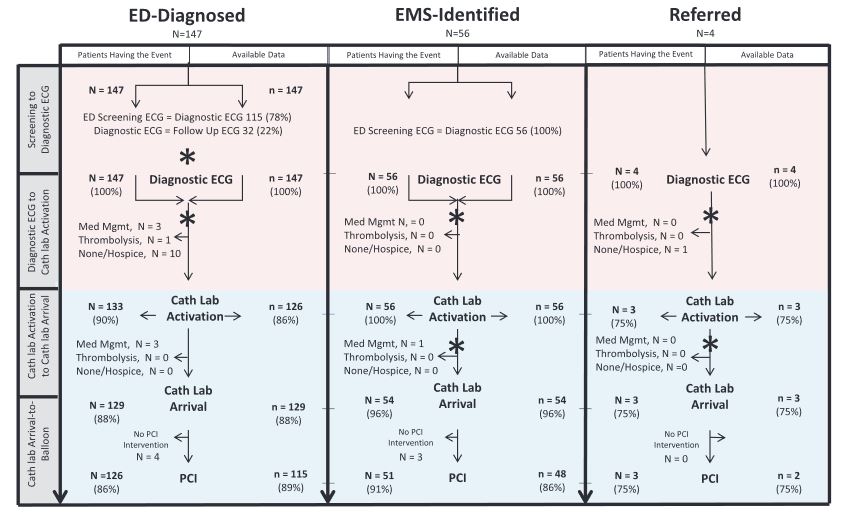
ST-segment elevation myocardial infarction (STEMI) patients’ care course
and treatment intervals by location of diagnosis
Yiadom, M., Olubowale, O., Jenkins, C., Miller, K., West, J., Vogus, T., . . . Liu, D. (n.d.). Understanding timely STEMI treatment performance: A 3-year retrospective cohort study using diagnosis-to-balloon-time and care subintervals. Journal of the American College of Emergency Physicians Open., 2(1), E12379
Saberian, P., Tavakoli, N., Ramim, T., Hasani-Sharamin, P., Shams, E., & Baratloo, A. (2019). The Role of Pre-Hospital Telecardiology in Reducing the Coronary Reperfusion Time; a Brief Report. Archives of Academic Emergency Medicine., 7(1), E15.
Poulin, M., Appis, A., Purim-Shem-Tov, Y., Schaer, G., & Snell, J. (n.d.). Impact of a novel interventional platform and hospital design on the door-to-balloon time in patients presenting with ST-segment elevation myocardial infarction. Critical Pathways in Cardiology., 14(1), 39-43.
Full Text for Emory Users
LO33: Sharing and teaching electrocardiograms to minimize infarction…Canadian Association of Emergency Physicians (CAEP/ACMU) Conference, June 1-4, 2020, Ontario, Canada. (2020). Canadian Journal of Emergency Medicine. 22 (S1), S19.
Full Text for Emory Users
 Evidence Matters