
Despite recognized health benefits for both mothers and infants, significant disparities still exist in the rates of breastfeeding in the United States. This article reviews the evidence related to barriers (prenatal, medical, societal, hospital, and sociocultural) that many mothers face, and explore the known barriers and the impact they have on a woman’s ability to breastfeed her infant.Strategies will be discussed to address (and potentially overcome) some of the most common barriers women face along with a list of resources that can be useful in this effort.
From: Sriraman, Natasha, et al
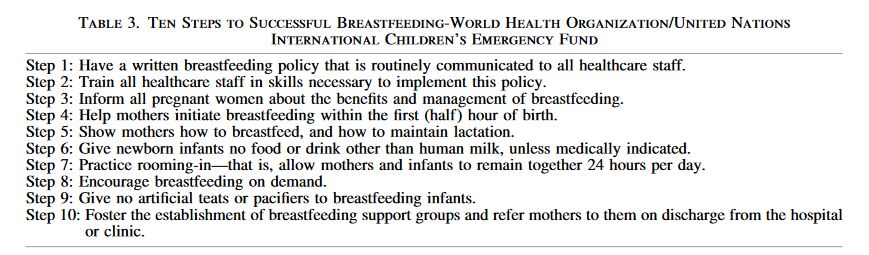
From: Sriraman, Natasha, et al
Resources
Sayres, S., & Visentin, L. (2018). Breastfeeding: Uncovering barriers and offering solutions. Current Opinion in Pediatrics., 30(4), 591-596.
For Emory Users
Louis-Jacques, A., Deubel, T., Taylor, M., & Stuebe, A. (2017). Racial and ethnic disparities in U.S. breastfeeding and implications for maternal and child health outcomes. Seminars in Perinatology., 41(5), 299-307.
For Emory Users
Bartick, M., Jegier, B., Green, B., Schwarz, E., Reinhold, A., & Stuebe, A. (2017). Disparities in Breastfeeding: Impact on Maternal and Child Health Outcomes and Costs. The Journal of Pediatrics., 181, 49-55.e6.
For Emory Users
Johnson A, Kirk R, Rosenblum KL, Muzik M. Enhancing breastfeeding rates among African American women: a systematic review of current psychosocial interventions. Breastfeed Med. 2015 Jan-Feb;10(1):45-62.
For Emory Users
Beauregard JL, Hamner HC, Chen J, Avila-Rodriguez W, Elam-Evans LD, Perrine CG. Racial Disparities in Breastfeeding Initiation and Duration Among U.S. Infants Born in 2015. MMWR Morb Mortal Wkly Rep. 2019 Aug 30;68(34):745-748
For Emory Users
 Evidence Matters