
A QI initiative aimed at reducing the number of interruptions and distractions experienced by nurses during the medication administration process examined the effects of:
- introduction of a medication administration room
- standardization of the medication administration process
These changes in practice had significant impact, resulting in “an 88.5% reduction in distractions and interruptions.[1]”
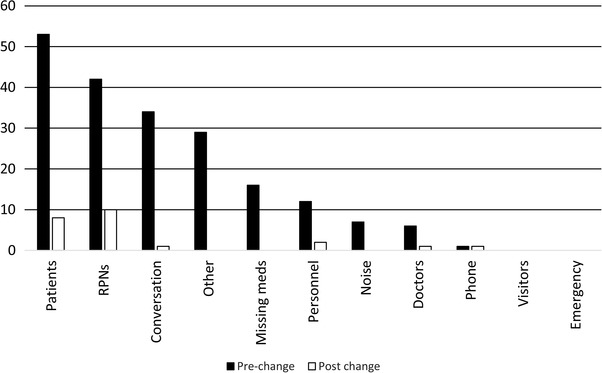
Number of distractions or interruptions per source pre- and postimplementation of practice change.
Kavanagh A, Donnelly J. A Lean Approach to Improve Medication Administration Safety by Reducing Distractions and Interruptions. J Nurs Care Qual. 2020 Oct/Dec;35(4):E58-E62. doi: 10.1097/NCQ.0000000000000473. PMID: 32079961.
Full text access for Emory Users.
Further reading:
Flynn F, Evanish JQ, Fernald JM, Hutchinson DE, Lefaiver C. Progressive Care Nurses Improving Patient Safety by Limiting Interruptions During Medication Administration. Crit Care Nurse. 2016 Aug;36(4):19-35. doi: 10.4037/ccn2016498. PMID: 27481799.
Full text access for Emory Users.
Agarwal P, Poeran J, Meyer J, Rogers L, Reich DL, Mazumdar M. Bedside medication delivery programs: suggestions for systematic evaluation and reporting. Int J Qual Health Care. 2019 Oct 31;31(8):G53-G59. doi: 10.1093/intqhc/mzz014. PMID: 31053860.
Full text access for Emory Users.
Wolak E, Hill A, Ball P, Culp L. A Novel Approach to Reducing RN Distraction During Medication Access. Medsurg Nurs. 2017 Mar;26(2):93-98. PMID: 30304588.
Full text access for Emory Users.
Keers RN, Williams SD, Cooke J, Ashcroft DM. Causes of medication administration errors in hospitals: a systematic review of quantitative and qualitative evidence. Drug Saf. 2013 Nov;36(11):1045-67. doi: 10.1007/s40264-013-0090-2. PMID: 23975331; PMCID: PMC3824584.
Sutherland A, Ashcroft DM, Phipps DL. Exploring the human factors of prescribing errors in paediatric intensive care units. Arch Dis Child. 2019 Jun;104(6):588-595. doi: 10.1136/archdischild-2018-315981. Epub 2019 Feb 8. PMID: 30737262; PMCID: PMC6557218.
Additional resources:
 Evidence Matters